For years, adventure motorcycles seemed to follow a predictable rule.
More displacement meant more capability.
A 650 was better than a 400.
An 800 was better than a 650.
And if your budget allowed it, a 1000cc or 1200cc machine represented the logical destination.
Then riders actually took them off road.
And something interesting happened.
As adventure motorcycles became more powerful, more comfortable and more technologically sophisticated, they also became heavier, more expensive and increasingly intimidating when the trail stopped cooperating.
That has created renewed interest in a category that may represent the most useful part of the ADV market:
the 400 to 450cc adventure motorcycle.
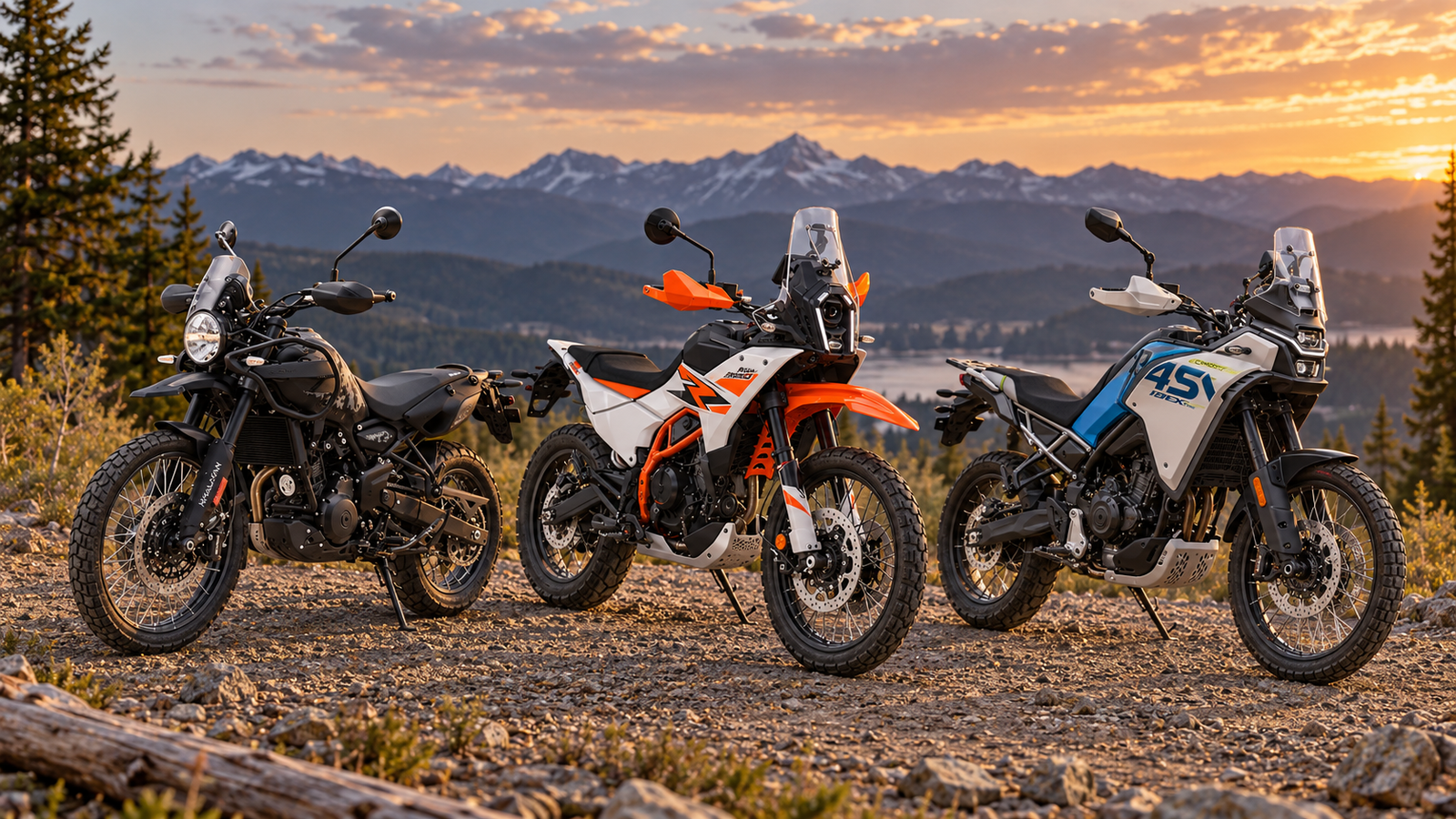
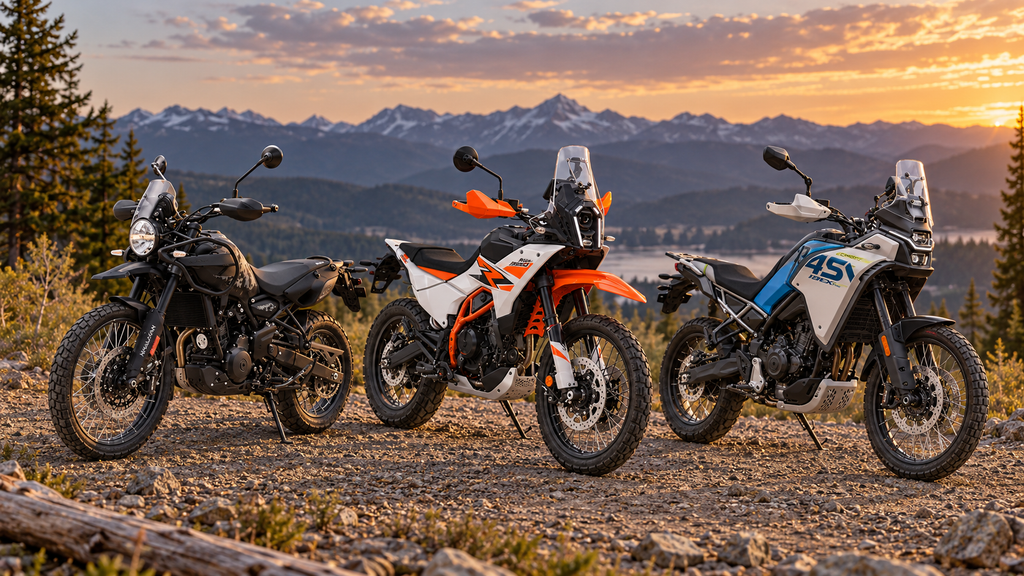
Three bikes now illustrate just how varied that category has become.
The CFMOTO Ibex 450.
The Royal Enfield Himalayan 450.
And the KTM 390 Adventure R.
They all promise legitimate travel capability without the mass of a full-size ADV bike.
But they arrive at that goal in very different ways.
The Ibex uses a smooth parallel twin.
The Himalayan emphasizes simplicity, range and all-day travel.
The KTM pushes hardest toward enduro territory.
So which one occupies the lightweight ADV sweet spot?
The answer depends on what you expect an adventure motorcycle to do.
First, What Do We Mean by “Lightweight ADV”?
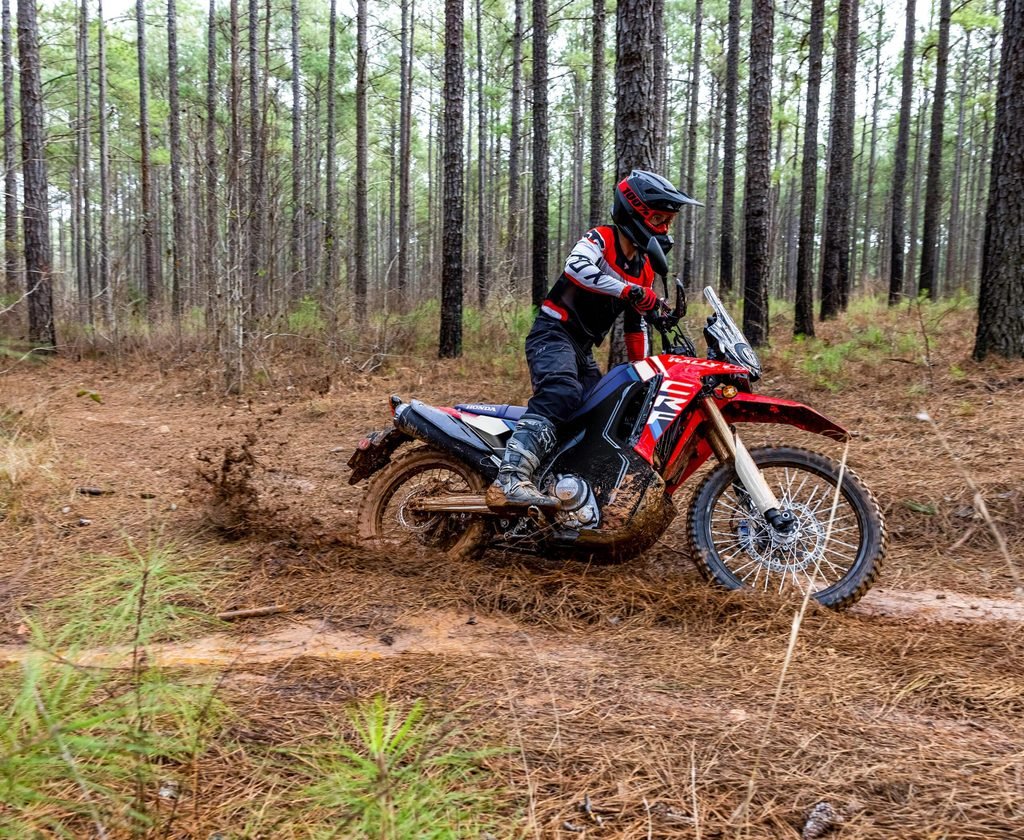
There is no official definition.
A 250 pound dual sport is unquestionably lighter than any of these motorcycles.
But a dual sport and a small adventure motorcycle aren’t trying to solve exactly the same problem.
An adventure bike needs enough road capability to travel meaningful distances.
Enough fuel to operate away from services.
Enough subframe to carry luggage.
Some weather protection.
Useful instrumentation.
And enough comfort that the rider doesn’t start searching for a trailer after 100 miles.
That equipment adds weight.
The goal isn’t necessarily to make the lightest motorcycle possible.
It’s to find the point where travel capability and off road manageability intersect.
That’s the sweet spot we’re looking for.
Ibex 450 vs Himalayan 450 vs 390 Adventure R: The Stats
| Specification | CFMOTO Ibex 450 | Royal Enfield Himalayan 450 | KTM 390 Adventure R |
|---|---|---|---|
| Engine | 449cc parallel twin | 452cc single | 399cc single |
| Claimed power | ~44 hp | 40 PS | 45 PS |
| Claimed torque | ~32.5 lb-ft | 40 Nm / 29.5 lb-ft | 39 Nm / 28.8 lb-ft |
| Transmission | 6-speed | 6-speed | 6-speed |
| Front wheel | 21 in | 21 in | 21 in |
| Rear wheel | 18 in | 17 in | 18 in |
| Front travel | ~7.9 in | 7.9 in | 9.1 in |
| Rear travel | ~7.9 in | 7.9 in | 9.1 in |
| Ground clearance | ~8.7 in | 9.1 in | 10.7 in |
| Seat height | 32.3 in | 32.5–33.3 in | 34.3 in |
| Fuel capacity | 4.6 gal | 4.5 gal | 3.7 gal |
| Ready-to-ride weight | ~419 lb | ~432 lb | 388 lb fully fueled |
| Starting U.S. MSRP | $5,999 | $5,999 | $7,699 + freight |
The Himalayan’s official specification lists 196 kg curb weight, 200 mm suspension travel, 230 mm ground clearance and a 17 liter tank. KTM lists the 390 Adventure R at 176 kg fully fueled, with 230 mm of travel at both ends and an unusually generous 272 mm of ground clearance.
And immediately, the personalities emerge.
The KTM is the lightest and most aggressively suspended.
The Himalayan is the heaviest but arguably the most travel oriented.
The Ibex sits between them while offering the only twin cylinder engine.
That’s much more interesting than three motorcycles competing over the same specification sheet.
CFMOTO Ibex 450: The Middle Ground
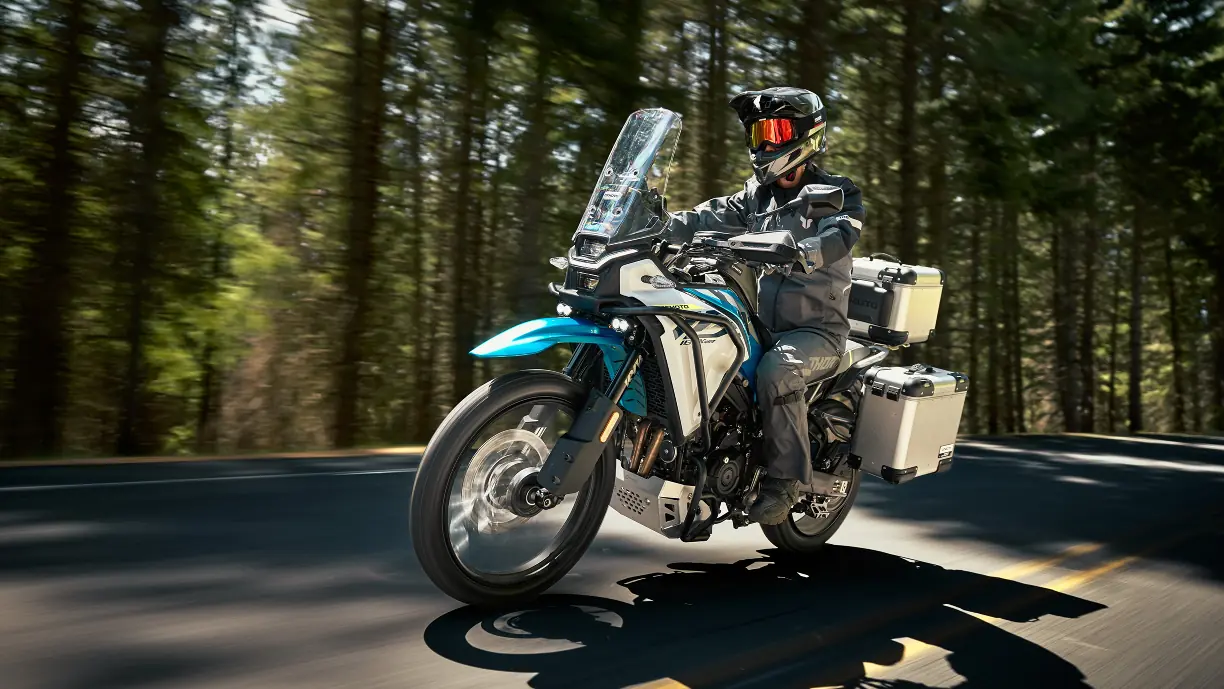
The Ibex 450 may be the easiest motorcycle of the three to understand.
It’s trying to do almost everything reasonably well.
Its 449cc parallel twin produces roughly 44 horsepower, while the chassis uses a dirt-oriented 21 inch front and 18 inch rear wheel combination.
Seat height is an approachable 32.3 inches, and current CFMOTO dealer network listings put the 2027 model at $5,999.
But the engine configuration is what really separates it.
Two Cylinders Change the Character
Both the Himalayan and KTM use single cylinder engines.
The Ibex uses a parallel twin.
That adds some weight and complexity, but it also changes the motorcycle’s road manners.
A small parallel twin generally offers smoother sustained operation at highway speeds than a large single.
That’s potentially important on an adventure motorcycle.
The Ibex doesn’t need to be the best motorcycle on the interstate.
It simply needs to make long connecting sections tolerable enough that the rider doesn’t wish they’d chosen something larger.
Then, when pavement ends, approximately 419 pounds keeps it much more manageable than traditional middleweight adventure bikes.
That combination is compelling.
The Ibex 450 may be the bike for riders who refuse to choose completely between road comfort and trail manageability.
Royal Enfield Himalayan 450: The Traveler
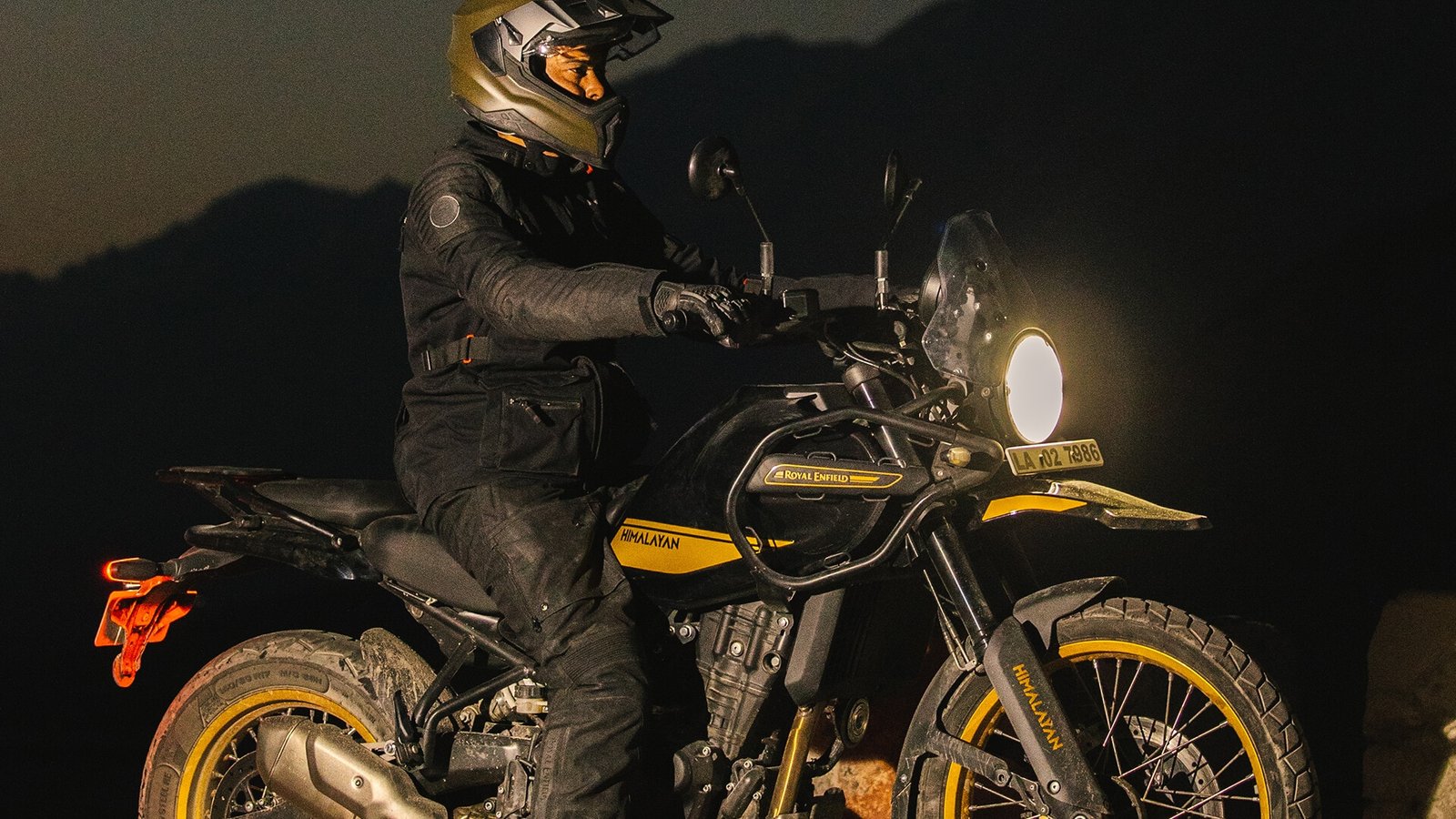
The Himalayan takes a different approach.
Royal Enfield has never seemed particularly interested in winning horsepower comparisons with the Himalayan.
That isn’t the point.
The new liquid-cooled Sherpa 450 single produces approximately 40 PS and 40 Nm, feeding through a six speed gearbox. Royal Enfield pairs it with a 17 liter or about 4.5-gallon fuel tank, 200 mm of suspension travel, and a 21 inch front wheel.
Those numbers look modest.
They also make a great deal of sense for long distance travel.
The Himalayan’s entire identity is built around going somewhere.
Not necessarily going there fastest.
The Himalayan Doesn’t Pretend to Be an Enduro
That’s one of its strengths.
Royal Enfield gives the Himalayan a 21 inch front wheel, decent suspension travel, and enough ground clearance for legitimate dirt use.
But unlike the KTM, it isn’t trying to convince anyone that it belongs on an enduro course.
Its 17 inch rear wheel, approximately 432-pound curb weight, and comfortable adjustable seat reveal the priorities.
This is a travel motorcycle that can handle bad roads, not a competition-inspired motorcycle reluctantly carrying luggage.
And for many riders, that’s exactly the correct formula.
Royal Enfield itself emphasizes the bike’s mix of 21/17 wheels, Showa suspension, 17-liter tank, adjustable seat, and travel-focused ergonomics.
The Himalayan’s Secret Weapon Is Simplicity of Purpose
Imagine an adventure that looks like this:
Two hundred miles of secondary roads.
A mountain pass.
Gravel.
A deteriorating forest road.
A night at a campsite.
Another 250 miles the next day.
No one is timing the route.
No one is trying to clear a tabletop.
No one particularly cares whether the bike produces 40 horsepower or 45.
You want range.
Comfort.
Predictable power.
Luggage capacity.
And a motorcycle that doesn’t become miserable when the asphalt disappears.
That’s where the Himalayan’s philosophy makes sense.
It isn’t necessarily trying to be the most capable motorcycle in this comparison. It’s trying to be the motorcycle most content to keep traveling.
KTM 390 Adventure R: The Dirt Bike of the Group
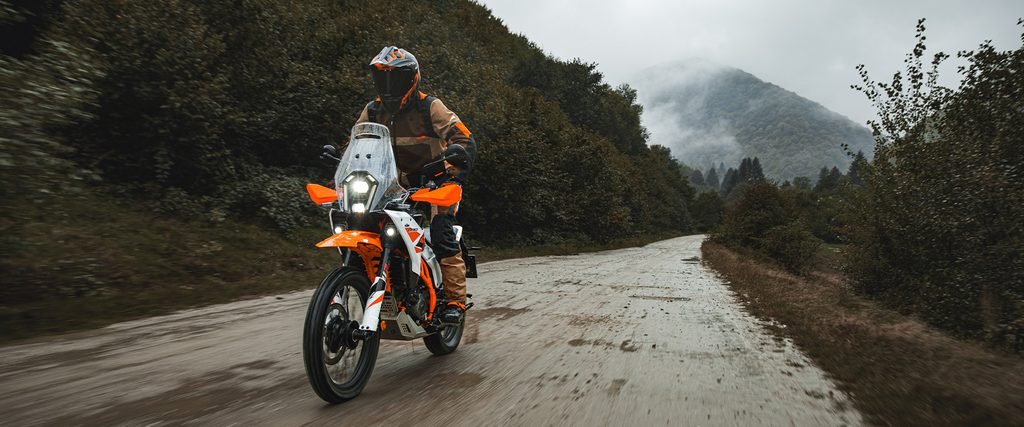
Then there’s the KTM.
The 390 Adventure R approaches the lightweight ADV category from almost the opposite direction.
KTM gives it a 398.7cc single producing a claimed 45 PS and 39 Nm, but the engine isn’t the most interesting part.
Look at the chassis.
230 mm or 9.1 inches of WP APEX suspension travel at both ends.
272 mm or 10.7 inches of ground clearance.
21/18 inch spoked wheels.
And just 176 kg, or about 388 pounds, fully fueled.
Those are serious numbers.
KTM explicitly describes the R as the off-road-oriented version of the 390 Adventure, with adjustable WP suspension, rally-style ergonomics, and 21/18 wheels.
The intent isn’t subtle.
Thirty Pounds Matters
The KTM is roughly 30 pounds lighter than the Ibex and more than 40 pounds lighter than the Himalayan.
That’s meaningful.
Not because 30 or 40 pounds changes whether a motorcycle can cross a gravel road.
All three can.
It matters when:
The trail gets steep.
The front wheel deflects off a rock.
You need to pivot the motorcycle around.
You’re balancing halfway across a rut.
Or the bike ends up lying on the ground.
That’s where the KTM begins separating itself.
And its additional suspension travel and ground clearance amplify that advantage.
If technical terrain is your priority, the specification sheet strongly favors the orange bike.
But the KTM Makes You Pay for It
Light weight gets expensive surprisingly quickly.
The current 390 Adventure R carries a $7,699 MSRP plus $600 freight in the United States.
That puts it significantly above the base price of both the Ibex 450 and Himalayan 450.
The difference buys real hardware.
WP APEX suspension.
Lower weight.
More ground clearance.
A dirt-focused 21/18 setup.
Cornering traction control.
Cornering ABS.
Off road ABS.
KTM isn’t charging more simply because the fuel tank is orange.
But riders need to decide whether they’re actually going to use what they’re paying for.
The Suspension Question
This may be one of the biggest distinctions among the three motorcycles.
Both the Ibex and Himalayan offer roughly 200 mm or 7.9 inches of suspension travel.
That’s plenty for the majority of adventure travel.
The KTM offers 230 mm or 9.1 inches.
That extra inch plus doesn’t matter much cruising a gravel road.
Hit repeated rocks at speed, deep erosion, ledges or aggressive off-road terrain, and it can matter quite a lot.
The KTM also offers adjustable compression and rebound at the fork and rebound adjustment at the rear.
This makes the KTM less of a small ADV motorcycle with off-road ability and more of a genuine small off road motorcycle with ADV ability.
That’s an important distinction.
21/18 vs 21/17
Both the CFMOTO and KTM use the traditional off-road 21/18 inch combination.
The Himalayan pairs its 21 inch front with a 17 inch rear.
For most adventure riders, that isn’t remotely a deal-breaker.
A 17 inch rear offers plenty of dual-sport tire options.
But an 18 inch rear remains the more dirt oriented standard and opens access to a wider range of aggressive off road tires.
Another small advantage to the CFMOTO and KTM when dirt becomes the priority.
Which Engine Would We Want?
This is where the decision becomes much less obvious.
The Ibex Twin
The Ibex’s twin cylinder engine should be the smoothest choice for sustained road travel.
It makes roughly as much peak power as the KTM but distributes the experience differently.
If your trip involves several hundred miles of highway before hitting dirt, that refinement could matter more than an extra inch of suspension travel.
The Himalayan Single
The Royal Enfield’s big single is about usable torque and simplicity of character rather than maximum performance.
It produces peak torque lower than peak power, which fits the bike’s travel-oriented mission.
The KTM Single
The KTM offers the highest specific performance of the three.
It has less displacement than either rival yet produces a claimed 45 PS.
That’s classic KTM thinking.
Smaller.
Lighter.
More highly stressed.
More performance focused.
Which is best?
There isn’t one answer.
Twin for refinement.
Himalayan single for relaxed travel.
KTM single for performance.
Highway: Advantage Ibex
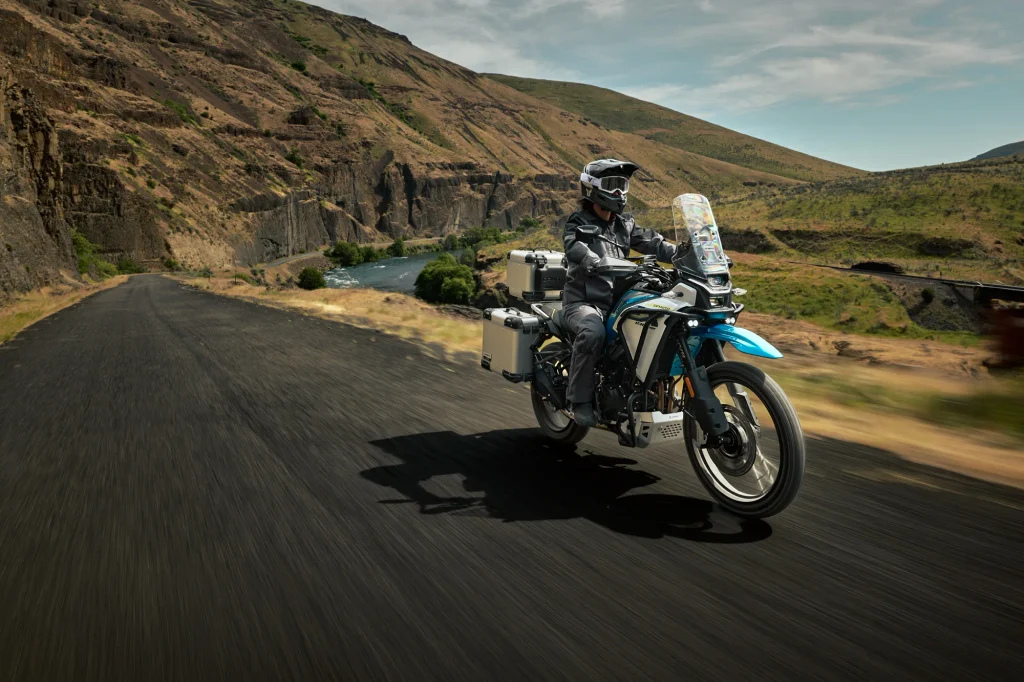
If the trip involves substantial interstate travel, the Ibex is probably the one we’d want to try first.
Not because it has dramatically more horsepower.
It doesn’t.
Because the parallel twin architecture should inherently provide smoother sustained high speed running than the singles.
That matters at 70 or 75 mph.
Especially after several hours.
The Himalayan may counter with its relaxed character and comfortable travel ergonomics, but the CFMOTO’s engine configuration makes it particularly intriguing as the most genuinely mixed use motorcycle of the group.
Long Distance Back roads: Advantage Himalayan
Move away from interstate speeds and the Royal Enfield starts making a very persuasive case.
The Himalayan was conceived around travel.
Its 17-liter tank, adjustable seat, upright ergonomics and integrated navigation-capable TFT all reinforce that mission.
This might be the motorcycle we’d choose for a trip involving:
Secondary roads.
Mountain passes.
Two-lane highways.
Gravel.
Camping.
Long days.
And no particular interest in getting anywhere quickly.
There’s something appealing about a motorcycle designed around that pace.
Technical Dirt: Advantage KTM
This one’s fairly straightforward.
The KTM is:
Lighter.
Taller.
Higher off the ground.
Better suspended.
And fitted with the wheel sizes we’d expect from a serious dirt-oriented motorcycle.
If we knew beforehand that a route included repeated difficult sections, the 390 Adventure R would be our first pick on paper.
The caveat matters.
Its 34.3 inch seat is substantially taller than either competitor.
That could make the KTM more intimidating for shorter riders precisely when the terrain becomes difficult.
Capability means little if the motorcycle doesn’t inspire confidence.
The Seat-Height Problem
This is one area where CFMOTO deserves particular attention.
The Ibex offers a 32.3 inch seat while retaining a 21 inch front wheel.
The Himalayan starts around 32.5 inches, adjustable upward to roughly 33.3, with an optional lower arrangement also available.
Then the KTM jumps to 34.3 inches.
Experienced riders correctly point out that seat height matters less once you’re moving.
They’re also correct that you’re eventually going to stop.
On uneven terrain.
Probably exactly where you didn’t want to.
For many riders, the lower CFMOTO or Royal Enfield may provide more usable real world confidence than the KTM’s superior theoretical capability.
Fuel Range: The KTM’s Biggest Compromise
The Ibex carries approximately 4.6 gallons.
The Himalayan carries roughly 4.5 gallons.
The KTM carries 3.7 gallons.
Fuel economy could narrow the actual range difference considerably, so we wouldn’t declare a range winner without real world testing.
But tank capacity matters on a travel motorcycle.
Particularly out West.
There are places where fuel stops aren’t conveniently spaced around what your motorcycle designer thought was sufficient.
An extra gallon can provide an enormous amount of psychological comfort when the low-fuel light comes on and the next town is still over the horizon.
This is one area where the Ibex and Himalayan look more naturally suited to self contained travel.
Which One Would We Want on a BDR?
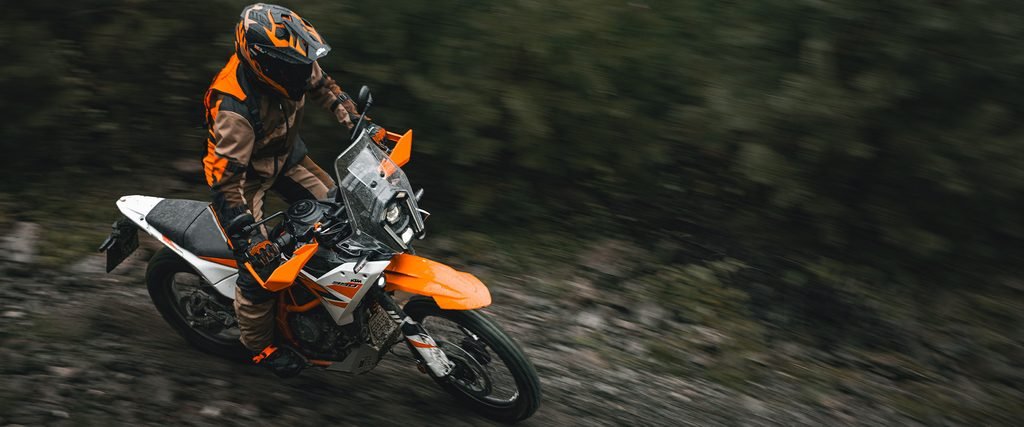
This is the question that gets to the heart of the comparison.
And our answer is:
It depends on which BDR and how you’re getting there.
If we expect the hardest terrain possible?
KTM 390 Adventure R.
If we’re traveling hundreds of pavement miles before the route begins and want a balanced motorcycle throughout?
CFMOTO Ibex 450.
If we’re approaching the route as part of a larger, slower paced journey with lots of back roads and camping?
Royal Enfield Himalayan 450.
That’s not avoiding the question.
It’s recognizing that a BDR isn’t one type of riding.
The Price Changes Everything
| Bike | Starting MSRP |
|---|---|
| CFMOTO Ibex 450 | $5,999 |
| Royal Enfield Himalayan 450 | $5,999 base 2027 configuration |
| KTM 390 Adventure R | $7,699 + $600 freight |
Current U.S. manufacturer/dealer network listings support those starting figures, although Himalayan pricing varies by color/equipment configuration.
The CFMOTO and Royal Enfield are virtually tied at the starting line.
The KTM asks for significantly more.
And this is where we need to think beyond MSRP.
What Could $2,000 Buy Instead?
The difference between an Ibex/Himalayan and KTM could fund much of an adventure setup.
Soft luggage.
Skid plate.
Protection.
GPS.
Camping equipment.
Better riding gear.
Off road training.
Tires.
And actual travel.
That doesn’t automatically make the cheaper motorcycle a better value.
If the KTM’s superior suspension and lower weight are exactly what your riding needs, they’re worth paying for.
But if you spend 90 percent of your time on pavement and gravel, buying expensive suspension merely because a spec sheet says it’s superior may not improve your adventures at all.
Value isn’t how much equipment the motorcycle has. It’s how much of that equipment you actually use.
Reliability and Dealer Support Matter Too
Specifications aren’t ownership.
And these motorcycles come from three very different ecosystems.
Royal Enfield has built the Himalayan around a global travel identity and backs new U.S. motorcycles with a three-year unlimited-mile warranty and roadside assistance.
KTM has an enormous off road heritage, extensive performance aftermarket, and a well-established Adventure community. KTM’s current U.S. information also advertises up to four years of manufacturer warranty coverage subject to its servicing terms.
CFMOTO is expanding rapidly and offering increasingly competitive hardware, but long term U.S. ownership history for bikes like the Ibex remains younger.
Parts availability.
Dealer competence.
Accessory support.
Resale value.
And what happens after 40,000 miles.
Those questions matter as much as suspension travel if you intend to own the motorcycle rather than merely test ride it.
Beginner Doesn’t Mean the Same Thing as Lightweight
All three could appeal to newer ADV riders.
But we’d stop calling motorcycles in this class “beginner bikes.”
A beginner may appreciate the Ibex’s low seat and smooth engine.
They may appreciate the Himalayan’s predictable power and travel focused character.
They may love the KTM’s lower overall mass.
But experienced riders benefit from all of those things too.
The most interesting development in lightweight ADV motorcycles isn’t that manufacturers are building better bikes for beginners.
It’s that they’re building small motorcycles experienced riders may choose deliberately.
Which One for an Experienced Rider?
Here’s where personal priorities really matter.
The experienced dirt rider who knows they’ll seek out technical terrain?
390 Adventure R.
The experienced traveler who has learned they don’t need 100 horsepower to explore another state?
Himalayan 450.
The experienced rider trying to reduce weight without giving up twin-cylinder refinement?
Ibex 450.
None of those choices represents settling.
They’re different tools.
The CFMOTO May Be the Actual Sweet Spot
This is where we come back to the premise.
The KTM has the most impressive dirt specifications.
The Himalayan arguably has the clearest travel philosophy.
But the Ibex 450 occupies the middle remarkably well.
It has:
A twin-cylinder engine.
21/18 wheels.
Roughly eight inches of suspension travel.
A low seat.
A meaningful fuel tank.
Approximately 419 pounds of ready to ride mass.
And a $5,999 starting price for 2027.
It doesn’t win every category.
And that’s exactly why it may be the sweet spot.
The best compromise isn’t the motorcycle that dominates one type of riding.
It’s the one that asks you to sacrifice the least across all of them.
But the KTM Is What We’d Want When the Trail Gets Ugly
We wouldn’t want to blur an obvious conclusion for the sake of balance.
If the road stops being a road, the KTM looks strongest.
Thirty plus fewer pounds.
More than an inch of additional suspension travel.
Substantially more ground clearance.
21/18 wheels.
Aggressive ergonomics.
The 390 Adventure R is closer to the lightweight adventure motorcycle many enthusiasts have been asking KTM to build for years.
That deserves recognition.
And the Himalayan May Be the One We’d Want to Own for Ten Years
There’s something else specifications don’t capture.
The Himalayan’s appeal isn’t based on being fastest, lightest, or most technically advanced.
It has a coherent purpose.
Load it.
Point it somewhere.
Keep going.
Royal Enfield has built an entire identity around that concept.
And there is a compelling simplicity to it.
For riders who see adventure travel as wandering rather than attacking terrain, that may matter more than winning any category in this comparison.
So Where Is the Lightweight ADV Sweet Spot?
Maybe there isn’t one motorcycle.
Maybe there are three.
CFMOTO Ibex 450: The All Rounder
Choose it if you want the broadest compromise between highway refinement, dirt ability, approachable ergonomics, and price.
Royal Enfield Himalayan 450: The Traveler
Choose it if the journey matters more than speed and your adventures emphasize backroads, range, luggage, and long days.
KTM 390 Adventure R: The Off-Road Choice
Choose it if technical terrain matters enough to justify the taller seat and higher purchase price.
But if the question is which one best represents the middle of the lightweight adventure bike equation, the Ibex 450 makes an unusually strong argument.
It doesn’t have the KTM’s ground clearance.
It doesn’t have quite the Himalayan’s singular travel focus.
Instead, it combines enough of both.
And perhaps that’s what the adventure bike sweet spot actually is.
Not the motorcycle with the most capability.
Not the motorcycle with the least weight.
Not the motorcycle with the lowest price.
It’s the motorcycle that makes you least likely to wish you’d brought something else.
For a surprising number of riders, the new lightweight ADV class may finally be delivering exactly that.
And at around $6,000 to $8,000 instead of $15,000 or $20,000, there’s another important benefit.
You may have enough money left to actually go somewhere.
Continue Reading
Is the Ibex 450 the Adventure Bike Most Riders Actually Need?
Ibex 450 vs Ibex 800 vs Ibex 950: Which CFMOTO Adventure Bike Should You Buy?
The Himalayan 440: Return of a Trusted Friend
CFMOTO Ibex 950 vs KTM 890 Adventure R: How Close Are They Really?