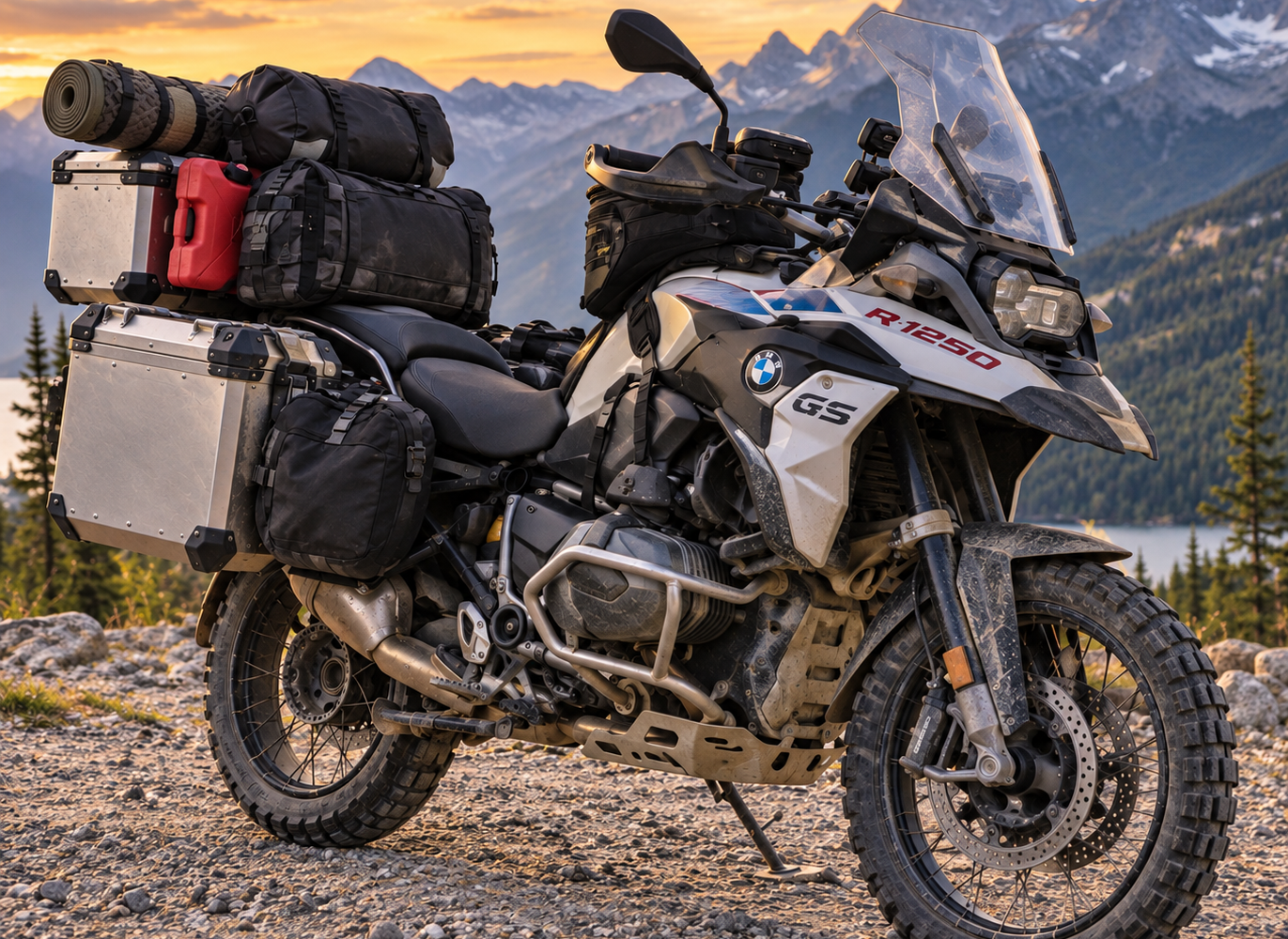
Adventure riders love arguing about weight.
The CFMOTO Ibex 450 is about 419 pounds.
The Yamaha Ténéré 700 is 459 pounds.
The KTM 890 Adventure R is roughly 474 pounds fully fueled.
And the new KTM 690 Rally looks positively featherweight by comparison.
We use those numbers to decide which motorcycle will be easier in sand, which one we’d rather pick up on a hillside and whether moving from a 450 to a 700 or from a 700 to a 900 adds too much motorcycle.
There’s just one problem.
Almost nobody rides an adventure motorcycle the way it was weighed by the manufacturer.
We add crash protection.
Luggage.
Tools.
Water.
Camping equipment.
Navigation.
Food.
Spare parts.
Extra clothing.
Maybe extra fuel.
Then we point the motorcycle toward a BDR and discover that the 419 pound motorcycle we bought because it was light isn’t a 419 pound motorcycle anymore.
So perhaps we’ve been asking the wrong question.
Instead of:
How much does the motorcycle weigh?
We should be asking:
How much does the motorcycle weigh when the adventure actually begins?
First, Motorcycle Weight Specifications Are a Mess
Before loading anything onto a motorcycle, we have to deal with an irritating problem.
Manufacturers don’t all describe weight the same way.
You’ll encounter terms including:
Dry weight.
Weight without fuel.
Wet weight.
Curb weight.
Ready to ride weight.
And those numbers don’t necessarily represent the same conditions.
Yamaha makes things relatively easy with the current Ténéré 700.
The 2026 T7 is listed at 459 pounds wet, and Yamaha explicitly says that figure includes standard equipment, oil, coolant and a full 4.2 gallon fuel tank.
That’s useful.
KTM provides two figures for the 2026 890 Adventure R: 200 kg without fuel and 215 kg fully fueled roughly 441 and 474 pounds respectively with a 5.28-gallon tank.
Also useful.
Then consider the new KTM 690 Rally.
KTM lists it at 161.5 kg about 356 pounds without fuel, with a 5.28-gallon fuel capacity. KTM does not currently list an official fully fueled weight on its U.S. specification page.
So comparing “356 pound 690 Rally” directly with a “459 pound Ténéré 700” would be misleading.
One motorcycle is carrying fuel in the published number.
The other isn’t.
And 5.28 gallons of gasoline isn’t weightless.
So Let’s Stop Comparing Incompatible Numbers
For this article, we’re going to use the most comparable ready to ride starting weight available.
Where the manufacturer publishes a fully fueled or curb figure, we’ll use it.
Where it doesn’t, we’ll clearly label our calculation as an estimate.
Then we’ll add exactly the same standardized travel load to each motorcycle.
Not because every rider packs identically.
They don’t.
But because it gives us something manufacturers’ specification sheets usually don’t:
a common reference point.
We’ll call it the:
In A Day’s Ride BDR Loadout
This isn’t intended to represent an ultralight minimalist.
And it isn’t the rider who brings a chair, espresso machine and three changes of shoes.
It’s a reasonable solo camping load for a multi day backcountry motorcycle trip.
What Are We Actually Carrying?
Here’s our initial standardized load.
| Category | Target Weight |
|---|---|
| Soft luggage / mounting system | 8 lbs |
| Tools, tire repair & recovery | 10 lbs |
| Camping equipment | 15 lbs |
| Water | 8 lbs |
| Food | 4 lbs |
| Clothing / weather layers | 5 lbs |
| Navigation / charging / electronics | 2 lbs |
| Miscellaneous essentials | 3 lbs |
| Total | 55 lbs |
Fifty-five pounds disappears onto an adventure motorcycle remarkably easily.
And this still isn’t an extravagant packing list.
What Does 55 Pounds Actually Look Like?
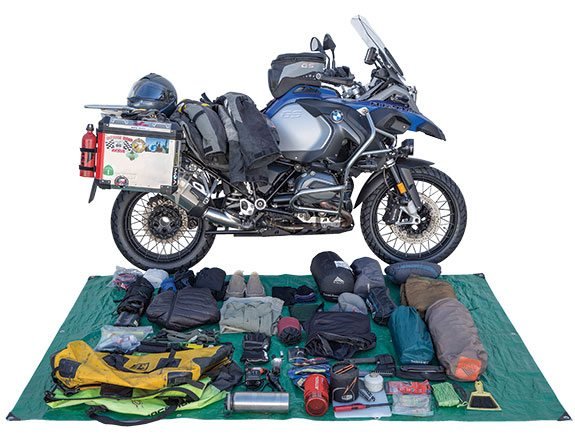
Eight pounds for luggage doesn’t require aluminum panniers. A set of soft bags, straps, dry bags, and mounting hardware can consume much of that allowance.
Ten pounds of tools and recovery equipment disappears quickly once you carry tire tools, inflation equipment, sockets, wrenches, repair materials, tow strap, and motorcycle-specific spares.
Fifteen pounds for camping gear includes a tent, sleeping bag, pad, and basic cooking equipment.
One gallon of water alone weighs about 8.3 pounds.
Then there are clothes, food, electronics, and all those tiny objects that apparently weigh nothing until they’re put on a scale together.
Fifty-five pounds is not difficult to reach.
The surprising part is how easily you can exceed it.
And We Haven’t Added Crash Protection Yet
This is important.
Our 55lb loadout does not include motorcycle specific modifications such as:
Crash bars.
Heavy skid plates.
Center stands.
Auxiliary lighting.
Navigation towers.
Larger windscreens.
Aftermarket racks.
Steering dampers.
Replacement handguards.
Auxiliary fuel tanks.
Those components vary too much between motorcycles to include fairly in a standardized load.
But they’re real.
And depending on how a motorcycle is equipped from the factory, preparing it for backcountry travel can add another substantial amount of weight before you’ve packed a single sock.
We’ll return to that.
The Lightweight Ibex Isn’t 419 Pounds Anymore
Let’s begin with the motorcycle that has driven much of our recent discussion.
The 2027 CFMOTO Ibex 450 is listed at 190 kg, or 418.9 pounds curb, with a 17.5 liter roughly 4.6 gallon fuel tank.
That’s one of its major advantages over conventional middleweight adventure motorcycles.
But now add our standardized load.
419 lb motorcycle
+ 55 lb BDR load
= approximately 474 lb
Suddenly our lightweight ADV weighs almost exactly what a stock, fully fueled KTM 890 Adventure R weighs before its rider packs anything.
That’s not an argument against the Ibex.
Quite the opposite.
It’s an illustration of why starting weight matters.
Because everything you pack gets added to whatever number you began with.
The Ténéré 700 Crosses 500 Pounds Quickly
Yamaha lists the 2026 Ténéré 700 at 459 pounds wet with its 4.2-gallon tank full.
Add exactly the same equipment:
459 lb motorcycle
+ 55 lb BDR load
= approximately 514 lb
There it is.
The motorcycle that many of us think of as a relatively simple, manageable middleweight ADV has crossed the 500 pound threshold.
And remember:
We haven’t added aftermarket crash bars or other motorcycle specific equipment.
A properly equipped T7 heading into the backcountry can therefore become a 500 plus pound motorcycle remarkably easily.
Now Look at the KTM 890 Adventure R
KTM makes this comparison unusually straightforward.
The company lists the 2026 890 Adventure R at 215 kg fully fueled, or approximately 474 pounds.
Add our load:
474 lb motorcycle
+ 55 lb BDR load
= approximately 529 lb
And again, that’s before bike specific accessories that may be added for the trip.
The 890 R is an extremely capable off road-oriented adventure motorcycle.
But capability doesn’t repeal physics.
Once loaded for travel, we’re talking about more than a quarter ton of motorcycle, and equipment.
Then the 690 Rally Changes the Conversation
This is where KTM’s new 690 Rally becomes particularly interesting.
KTM lists its weight without fuel at 161.5 kg, approximately 356 pounds, and fuel capacity at 5.28 gallons.
KTM hasn’t published a fully fueled U.S. weight, so we need to be careful.
Using roughly 6.1 pounds per U.S. gallon for gasoline, 5.28 gallons represents approximately 32 pounds of fuel.
That puts a theoretical full fuel 690 Rally around:
356 lb
+ ~32 lb fuel
= ~388 lb
That’s an IADR estimate, not an official KTM curb-weight specification.
Now add our travel equipment:
~388 lb estimated fueled motorcycle
+ 55 lb BDR load
= approximately 443 lb
Think about that.
A 690 Rally loaded with our entire hypothetical BDR camping kit could still weigh less than a completely unloaded Ténéré 700 with a full tank.
That’s a significant difference.
The Numbers Look Very Different Now
Using our standardized 55-pound travel load:
| Motorcycle | Comparable Starting Weight* | + BDR Load | Approx. Travel Weight |
|---|---|---|---|
| KTM 690 Rally | ~388 lb estimated | +55 | ~443 lb |
| CFMOTO Ibex 450 | 419 lb curb | +55 | ~474 lb |
| Yamaha Ténéré 700 | 459 lb wet | +55 | ~514 lb |
| KTM 890 Adventure R | 474 lb fully fueled | +55 | ~529 lb |
*The 690 Rally figure is an IADR fuel weight estimate based on KTM’s published 356-pound without fuel weight and 5.28 gallon capacity. The other figures use published curb/wet/fully fueled numbers where available.
This table tells a much more useful story than comparing engine displacement.
A 40 Pound Difference Doesn’t Disappear
When we compared the Ténéré 700 and Ibex 450, one of the central questions was whether the Yamaha’s additional power, proven platform, and highway performance justified approximately 40 pounds of additional motorcycle.
Loading them for travel doesn’t make that difference disappear.
It preserves it.
Ibex:
~474 lb loaded
Ténéré:
~514 lb loaded
Still about 40 pounds.
But psychologically, those numbers feel different.
A 419 pound motorcycle sounds light.
A 459 pound motorcycle sounds manageable.
A 474 pound travel motorcycle and a 514 pound travel motorcycle tell you more about what you’ll actually be wrestling with on a difficult climb.
Every Pound of Motorcycle Becomes a Permanent Passenger
Here’s the distinction between motorcycle weight and luggage weight.
You can remove luggage.
You can drink the water.
You can eat the food.
You can leave unnecessary equipment at home.
But the motorcycle’s base weight comes with you everywhere.
Every hill.
Every rut.
Every sand section.
Every creek crossing.
Every parking lot.
Every time you have to push backward.
Every time it falls over.
That’s why starting weight matters even after we load the bike.
But Packing Weight Deserves Just as Much Attention
There’s another lesson hiding here.
Riders will spend thousands of dollars reducing motorcycle weight.
Titanium exhaust.
Lithium battery.
Lightweight bodywork.
Smaller mirrors.
Machined components.
Then strap 70 pounds of luggage onto the back.
That doesn’t mean lightweight parts are pointless.
It means the cheapest weight reduction may be sitting on your garage floor.
Before spending $1,000 to remove eight pounds from a motorcycle, put everything you’re planning to pack on a scale.
The results may be uncomfortable.
Water Is the Silent Weight Killer
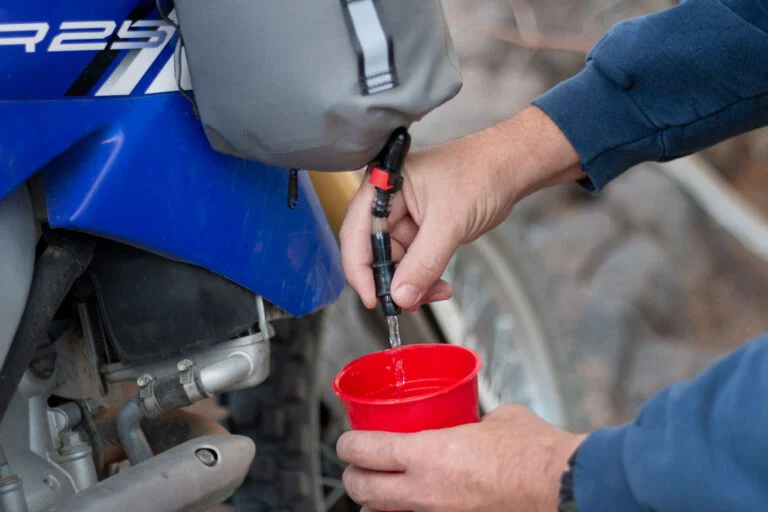
Water deserves special attention because adventure riding requires it and it is extremely heavy.
One U.S. gallon weighs about 8.3 pounds.
Two gallons:
16.6 pounds.
In hot, remote terrain, carrying substantial water isn’t optional.
Now add camping equipment.
Tools.
Food.
Fuel.
Suddenly the idea that you’re taking a “lightweight ADV bike” becomes relative.
This is why trip geography matters as much as the motorcycle.
A Pacific Northwest forest route with frequent towns and water sources creates a very different load requirement than remote desert riding.
Extra Fuel Creates the Same Problem
Fuel is another variable.
Our standardized comparison assumes the motorcycle’s normal tank is full.
But some routes require additional range.
One extra gallon of gasoline adds roughly six pounds before accounting for the container or mounting system.
Two gallons can add 12-plus pounds.
And unlike a larger factory tank designed into the motorcycle, auxiliary fuel is often carried somewhere less ideal.
Rear rack.
Pannier.
RotopaX mount.
Soft fuel bladder.
Where weight sits matters almost as much as how much it weighs.
Fifty Pounds Low Isn’t the Same as Fifty Pounds High
This is where specification sheet weight becomes even less useful.
Imagine two motorcycles weighing exactly 500 pounds.
One carries most of its fuel low and near the center of the chassis.
The other carries luggage, fuel, and tools high behind the rider.
Same scale weight.
Very different motorcycle.
Weight distribution affects:
Steering.
Balance.
Suspension behavior.
Traction.
How quickly the bike changes direction.
How difficult it feels when leaning away from you.
That’s one reason KTM’s low mounted fuel architecture on motorcycles like the 890 Adventure matters.
The motorcycle isn’t light.
But KTM has worked to put substantial mass low in the chassis.
The scale can’t tell you how a motorcycle carries its weight.
The trail will.
Rear Luggage Can Change the Motorcycle More Than You Expect
Adventure riders naturally put luggage behind themselves.
That’s where the space is.
Unfortunately, adding substantial mass behind the rear axle changes chassis behavior.
The rear suspension compresses.
Steering geometry changes.
Front-end weight decreases.
The motorcycle can feel vague.
Headlight aim changes.
Ground clearance decreases.
And suspension designed around an unloaded rider may suddenly be operating far outside its ideal range.
This is why preload exists.
It’s also why suspension setup becomes part of trip preparation.
Your Suspension Has to Carry the Adventure Too
A motorcycle that feels excellent during a solo test ride may behave very differently with 55 pounds of travel equipment.
Add a passenger and the difference becomes enormous.
Adventure bike payload discussions often focus on whether the subframe can physically carry the load.
That’s only part of the problem.
The suspension has to control it.
Before a long trip, riders should be checking:
Sag.
Preload.
Tire pressures.
Load distribution.
And the motorcycle’s maximum permitted load.
Packing isn’t merely storage.
It’s chassis setup.
Hard Panniers Can Move the Goalposts Quickly
There’s a reason our standardized kit assumes relatively light soft luggage.
Hard luggage has advantages.
Security.
Weather resistance.
Organization.
Convenience.
Durability.
But aluminum panniers, racks, and mounting hardware can add substantial weight before anything goes inside them.
Then there’s a psychological effect.
Large boxes invite you to fill them.
Adventure motorcycles have the same relationship with luggage capacity that garages have with shelving.
Empty space rarely remains empty.
Crash Protection Creates a Difficult Tradeoff
This is another ADV paradox.
We add weight to make motorcycles safer when they fall.
Crash bars.
Skid plates.
Radiator protection.
Handguards.
Case guards.
And those components can be absolutely worthwhile.
A six pound skid plate may save an engine case.
Crash protection may prevent a remote trip from ending after a simple fall.
So the objective isn’t:
Remove every ounce.
It’s:
Make every pound justify itself.
That’s a much better philosophy.
A Pound That Prevents a Breakdown Is Different
Not all weight is bad.
Tools weigh something.
Water weighs something.
Protection weighs something.
A first aid kit weighs something.
Satellite communication weighs something.
Those are useful pounds.
The goal isn’t to build the lightest possible motorcycle at the expense of being prepared.
It’s to eliminate weight that doesn’t meaningfully improve the trip.
There’s a big difference.
Ask Every Item the Same Question
When packing, pick up an item and ask:
What problem does this solve?
If the answer is clear, pack it.
If the answer is:
“Well, maybe…”
Think again.
Do that 30 times and you can remove a surprising amount of weight without compromising safety or comfort.
The BDR Test Looks Different at 500 Pounds
We’ve used the BDR as a recurring benchmark because it exposes the compromises in adventure motorcycle design.
Highway.
Gravel.
Rocks.
Mud.
Sand.
Mountain passes.
Camping.
Long days.
Remote sections.
A motorcycle can feel wonderful during the first 200 highway miles and completely different during the hardest five miles of the route.
That’s where travel weight matters.
Imagine picking up:
443 pounds.
Then:
474 pounds.
Then:
514 pounds.
Then:
529 pounds.
Now imagine the motorcycle is lying slightly downhill.
The ground is loose.
You’re tired.
It’s hot.
You’ve already dropped it once.
Suddenly 30 or 40 pounds stops being an abstract specification.
This Doesn’t Mean Everyone Needs a 690 Rally
That would be the wrong conclusion.
The 890 Adventure R offers considerably more engine, highway performance, passenger capability, and touring versatility than a big single.
The Ténéré 700 remains an exceptionally compelling compromise between road and dirt.
The Ibex 450 offers accessibility, price and useful capability.
The 690 Rally appears extraordinarily focused.
Different missions justify different motorcycles.
The important thing is understanding what the weight number actually means for yours.
The Lightest Motorcycle Isn’t Automatically the Best
There’s another trap here.
Suppose Bike A weighs 30 pounds less than Bike B.
But Bike A needs:
A larger fuel tank.
A skid plate.
Handguards.
A luggage rack.
A navigation tower.
Wind protection.
By the time it’s prepared for the same mission, some of that advantage may disappear.
Factory equipment matters.
That’s why comparing showroom specifications is only the beginning.
The useful question is:
What does each motorcycle weigh when equipped to perform the same job?
That’s the comparison we’d ultimately like to measure ourselves.
This Is Where In A Day’s Ride Can Go Beyond the Spec Sheet
For now, we’re building a standardized model.
But there’s a much better version of this article in our future.
Actual motorcycles.
An actual scale.
An actual standardized loadout.
Weigh each motorcycle stock.
Weigh it after protection and accessories.
Weigh it fully packed.
Then weigh every category of gear individually.
No brochure numbers.
No estimates.
Just:
What does this motorcycle actually weigh when we’re ready to leave for a BDR?
That’s a test worth doing.
And once we establish the IADR loadout, we can repeat it with every adventure motorcycle we test.
We Need a Better Weight Number
Maybe adventure-bike reviews should stop reporting only curb weight.
For In A Day’s Ride, I’d like to eventually report three numbers:
Factory Weight
What the manufacturer claims.
IADR Ready Weight
The motorcycle as actually tested, including installed accessories and full fuel.
IADR Travel Weight
The motorcycle loaded with our standardized BDR kit.
Those three numbers tell riders far more than “dry weight.”
And because the same equipment can be used repeatedly, comparisons become increasingly meaningful.
The Rider Counts Too
There’s one more number we rarely discuss.
Us.
Motorcycle plus equipment is only part of the moving system.
Add the rider.
Then add riding gear.
Helmet.
Boots.
Jacket.
Armor.
Hydration pack.
Anything carried on the body.
The total system weight becomes substantial very quickly.
This is especially important when setting suspension sag and checking maximum load.
Adventure motorcycles don’t carry luggage.
They carry everything.
Maybe We Should Stop Asking Whether a Bike Is Heavy
“Heavy” isn’t particularly useful by itself.
A 530 pound motorcycle might be perfectly reasonable for two up highway travel.
It might be miserable for solo technical riding.
A 440-pound motorcycle may seem heavy next to an enduro.
It may feel remarkably light after stepping off a loaded heavyweight ADV.
The meaningful question is:
Heavy for what?
That’s the same mission first philosophy we’ve been applying throughout this series.
What Should You Do Before Your Next Trip?
Before your next multi day ride, try something simple.
Pack the motorcycle completely.
Not the night before.
Do it several days early.
Fill the fuel tank.
Fill the water containers.
Pack the food.
Load the tools.
Install the luggage.
Put everything exactly where it will be during the trip.
Then look at the motorcycle.
Better yet:
weigh everything.
You may discover that reducing your packing list by 15 pounds does more for the motorcycle than an expensive performance modification.
Then ride it before leaving.
Hard braking.
Low speed turns.
Standing.
Rough pavement.
Gravel if available.
Make sure the suspension, tires and load distribution still feel right.
The first time you discover the motorcycle handles badly when loaded shouldn’t be 300 miles from home.
Weight Is a Budget
Perhaps the best way to think about adventure bike weight is the same way we think about money.
You have a budget.
Spend it where it creates value.
Fuel?
Necessary.
Water?
Necessary.
Tools?
Necessary within reason.
Camping equipment?
Necessary if you’re camping.
Crash protection?
Often worth the cost.
A third pair of pants?
Maybe not.
A giant tool kit containing sockets that don’t fit anything on the motorcycle?
Definitely not.
Every pound needs a job.
The Specification Sheet Isn’t Lying, But It Isn’t Telling the Whole Truth
The title of this article is deliberately provocative.
Manufacturers generally aren’t hiding 50 pounds of secret motorcycle.
The problem is that the number we’re given answers a different question.
Manufacturer weight tells us:
What does the motorcycle weigh in a defined factory configuration?
Adventure riders need to know:
What will I have to manage when I’m tired, alone and halfway through the hardest section of my trip?
Those aren’t the same number.
Not even close.
419 Pounds Can Become 474 Very Quickly
That’s perhaps the simplest takeaway.
The Ibex 450 is still meaningfully lighter than the Ténéré 700.
The Ténéré remains lighter than many larger ADV motorcycles.
The 690 Rally appears exceptionally light for its range and capability.
Those differences are real.
But none of these motorcycles stays at brochure weight once adventure travel begins.
Our modest standardized load turns:
~388 into ~443.
419 into 474.
459 into 514.
474 into 529.
And real motorcycles with crash protection, racks and other accessories may weigh more.
That’s the motorcycle you actually ride.
The Next Question
We’ve spent much of this series asking how much motorcycle an adventure rider actually needs.
Weight gives us another way to approach that question.
But it leads naturally to something even more practical.
If every item we add makes the motorcycle harder to manage:
What equipment actually deserves to be there?
What protection do we really need?
What tools?
What luggage?
How much water?
Which spare parts?
What camping equipment?
What navigation and emergency gear?
And what are we carrying simply because adventure riders have been conditioned to pack it?
That’s where we’re going next.
Because the goal isn’t to build the lightest adventure motorcycle possible.
It’s to build one that’s prepared enough to get us there—
without carrying half the garage along for the ride.
Continue Reading
Ténéré 700 vs Ibex 450: Is the T7 Still the Adventure Bike Sweet Spot?
What does another 40 pounds and another $5,000 actually buy?
When Did Adventure Bikes Get Too Big?
How adventure motorcycles evolved toward more power, complexity, and mass.
The Best Adventure Bike Isn’t the Biggest One: How to Choose the Right ADV by Mission
Start with where you’re going, not engine displacement.
KTM Actually Did It: The 690 Rally Is the 640 Adventure Successor We Asked For
Why KTM’s new big single could revive the travel enduro category.
Is the Ibex 450 the Adventure Bike Most Riders Actually Need?
The case for less weight, manageable power, and more accessible adventure.