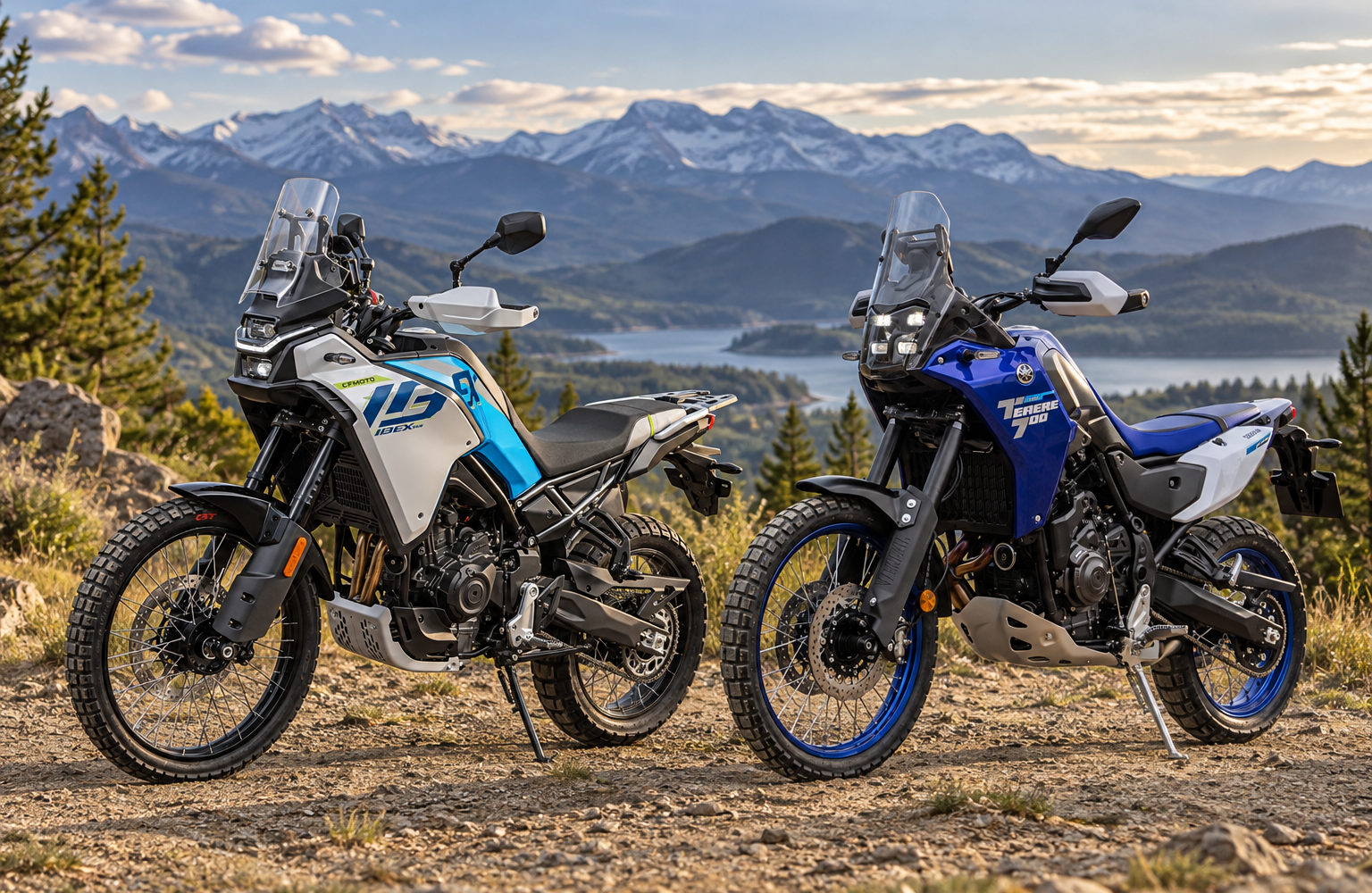
For years, the answer to a particular adventure motorcycle question has been remarkably easy.
You want enough power to travel.
You want real off road ability.
You don’t want a 550lbs motorcycle.
You value reliability more than gadgetry.
You want something simple enough to take into the middle of nowhere.
Buy a Yamaha Ténéré 700.
There are faster motorcycles.
There are lighter motorcycles.
There are more comfortable motorcycles.
There are motorcycles with better suspension.
But few have combined the essential pieces as successfully as Yamaha’s T7.
That’s why it became a benchmark.
But benchmarks eventually have to defend themselves.
And the motorcycle forcing the question may cost almost half as much.
The 2027 CFMOTO Ibex 450 starts at $5,999.
The 2026 Yamaha Ténéré 700 starts at $10,999, before Yamaha’s current $675 destination charge.
That’s a $5,000 MSRP gap before destination and dealer costs enter the equation.
So this isn’t simply a comparison between a 450 and a 700.
It’s a much more interesting question:
Does the Ténéré 700 give the average adventure rider $5,000 more motorcycle?
First, These Aren’t Direct Competitors
That needs to be said immediately.
The Ténéré 700 and Ibex 450 don’t occupy exactly the same category.
The Yamaha uses its well known 689cc CP2 parallel twin.
The CFMOTO uses a 449.5cc 270 degree parallel twin.
The T7 is more powerful.
It has more highway performance.
It has a much longer ownership history.
It has an enormous aftermarket.
And it has already proven itself around the world.
The Ibex can’t claim any of that to the same degree.
But they overlap in one critically important place:
mission.
Both are motorcycles someone might realistically buy to ride from home, travel highways and backroads, explore forest roads, tackle BDRs, and carry enough equipment to camp along the way.
That makes them competitors whether their engine sizes say so or not.
The Numbers Tell an Interesting Story
| Specification | 2026 Yamaha Ténéré 700 | 2027 CFMOTO Ibex 450 |
|---|---|---|
| Engine | 689cc parallel twin | 449.5cc parallel twin |
| Power | 73.4 hp | 44 hp |
| Torque | 50 lb-ft | 32.5 lb-ft |
| Transmission | 6-speed | 6-speed |
| Fuel | 4.2 gal | 4.6 gal |
| Front wheel | 21 in | 21 in |
| Rear wheel | 18 in | 18 in |
| Front travel | 8.3 in | 7.9 in |
| Rear travel | 7.9 in | 7.9 in |
| Ground clearance | 9.4 in | 8.6–8.7 in |
| Seat height | 34.4 in | 32.3 in |
| Wet/curb weight | 459 lb | 418.9 lb |
| U.S. MSRP | $10,999 | $5,999 |
The Yamaha immediately wins several important measurements.
More engine.
More front suspension travel.
More ground clearance.
But then look at the other side.
The Ibex carries more fuel.
It sits roughly two inches lower.
It weighs about 40 pounds less ready to ride.
And it costs $5,000 less at MSRP.
Suddenly this becomes a very different comparison.
The CP2 Is the Ténéré’s Greatest Argument
If there is one reason to buy the T7 without reading the rest of this article, it’s Yamaha’s CP2 engine.
The 689cc parallel twin has earned an exceptional reputation across multiple Yamaha platforms.
Its appeal isn’t simply output.
It’s the way it delivers it.
Broad torque.
Predictable throttle response.
Enough power for highway passing.
Enough flexibility for dirt.
And a mechanical reputation that has become one of Yamaha’s strongest selling points.
Yamaha itself emphasizes the CP2’s reliability, broad delivery, and compact architecture as central to the Ténéré’s character.
For long distance riders, that matters enormously.
When you’re 100 miles from the nearest meaningful town, horsepower isn’t nearly as comforting as confidence that the motorcycle will start tomorrow morning.
The Ibex has to earn that reputation.
The Yamaha already has it.
But How Much Engine Do You Actually Need?
This is where things get interesting.
The Ibex makes 44 horsepower.
That sounds modest next to the T7.
On an interstate, it is.
Loaded with luggage, climbing a grade and trying to pass traffic at 80 mph, the Yamaha’s extra displacement matters.
But what happens when pavement ends?
Most riders aren’t using 70 horsepower on a loose forest road.
They aren’t using it climbing a rocky switchback.
They aren’t using it crossing a shallow stream.
They aren’t using it negotiating a washed out BDR section.
At that point, controllability starts mattering more than output.
And 44 horsepower suddenly doesn’t sound inadequate.
It sounds useful.
The Ibex Has One Important Advantage: 40 Pounds
Adventure motorcycle weight is strange.
Forty pounds doesn’t sound dramatic in a dealership.
It becomes considerably more noticeable on a hillside.
The Ténéré weighs 459 pounds wet.
The Ibex is about 419 pounds curb.
That’s roughly a 40lbs difference.
And unlike horsepower, the effect of weight never disappears.
You feel it:
Braking.
Turning.
Picking through rocks.
Descending.
Changing lines.
Pushing the motorcycle backward.
Lifting it after a fall.
And recovering from mistakes.
This is why comparing ADV motorcycles purely by power to weight misses the point.
A lighter motorcycle doesn’t merely accelerate differently.
It asks less from the rider.
Then Add Camping Equipment
Now the comparison becomes more relevant.
Neither motorcycle will remain at its published weight.
Add:
Crash protection.
Luggage racks or soft luggage supports.
Camping equipment.
Tools.
Water.
Food.
Spare tubes or repair equipment.
Navigation equipment.
Cold weather layers.
Maybe another gallon of fuel.
A 459lbs T7 can become a 500lbs plus travel motorcycle surprisingly quickly.
The Ibex gains the same equipment weight.
But it begins the trip roughly 40lbs ahead.
That margin matters.
The T7 Still Has the Better Chassis Numbers
We shouldn’t overstate the Ibex advantage.
Yamaha gives the T7 8.3 inches of front travel, 7.9 inches at the rear and 9.4 inches of ground clearance.
The Ibex has approximately 7.9 inches of KYB travel at both ends and roughly 8.6–8.7 inches of clearance.
Both use proper 21/18in adventure wheel sizes.
But the Yamaha provides more room underneath and slightly more front suspension travel.
For riders who regularly attack rough terrain at speed, those numbers matter.
The T7’s advantage isn’t enormous.
It is real.
The Ibex Has a Surprisingly Serious Chassis
That’s perhaps the bigger story.
At $5,999, it would be reasonable to expect obvious cost cutting.
Instead, CFMOTO gives the Ibex adjustable KYB suspension.
The front fork offers preload, compression and rebound adjustment.
The rear provides preload and rebound adjustment.
The wheels are 21/18in tubeless spokes.
There’s a 320mm J.Juan front disc.
Rear ABS can be switched off for dirt.
This isn’t a street motorcycle wearing an adventure costume.
The underlying specification was clearly designed with dirt riding in mind.
Tubeless Wheels Matter More Than They Sound
This is one area where the Ibex deserves attention.
The CFMOTO uses tubeless spoked wheels.
For travel, that’s a meaningful feature.
A simple puncture can potentially be repaired with a plug without removing the wheel.
For a rider alone on a BDR, that’s not a glamorous specification.
It’s an extremely useful one.
Adventure equipment should be judged by whether it makes the trip easier.
Tubeless 21/18in wheels do.
Seat Height Changes Who Can Use the Motorcycle
The T7’s 34.4in seat isn’t extreme by serious ADV standards.
But it’s tall enough to intimidate some riders.
The Ibex sits at 32.3 inches.
Two inches is significant.
Especially when combined with the lower overall weight.
This doesn’t make the Ibex a beginner motorcycle.
It makes the motorcycle more accessible.
There’s an important distinction.
Experienced riders benefit from being able to get a foot down too.
Particularly when the ground underneath that foot is uneven, loose or unexpectedly several inches lower than expected.
Highway: Yamaha Wins
Let’s give the T7 its clearest victory.
If the trip involves long highway stretches, the Yamaha is the motorcycle I’d expect most riders to prefer.
The larger engine provides more reserve.
Passing is easier.
Loaded performance should be stronger.
Sustained high speeds demand less of the engine.
If your BDR trip begins with 600 miles of interstate, the Yamaha’s advantage becomes meaningful before you ever reach dirt.
This is the classic argument for the middleweight ADV.
It does the boring part of the trip better.
Dirt: The Answer Gets Complicated
Once the road becomes rough, the calculation changes.
The T7 has more ground clearance and slightly more front travel.
The Ibex weighs less.
Which matters more?
That depends on the rider.
A fast, experienced off road rider may exploit the Yamaha’s chassis and engine.
A slower or intermediate rider may gain considerably more from reducing the amount of motorcycle they’re managing.
That’s an important distinction.
The specification that’s best for an expert isn’t necessarily the specification that creates the most confidence for everyone else.
BDR: This Is Where I’d Want to Compare Them
Imagine a realistic BDR trip.
Not a promotional video.
A real trip.
Motorcycle loaded.
Camping equipment strapped on.
Water.
Tools.
A long day.
You’re tired.
Then you encounter the hardest five miles of the route.
Loose climb.
Rocks.
Ruts.
Maybe a washed out section.
The T7 has the stronger engine and more clearance.
The Ibex is approximately 40 pounds lighter.
Which would you rather pick up three times?
That’s not a rhetorical trick.
It’s a legitimate buying criterion.
Because the hardest part of an adventure ride isn’t always the terrain.
Sometimes it’s dealing with the motorcycle after something goes wrong.
The T7 Has Something CFMOTO Can’t Sell You
Time.
Years of it.
Thousands of owners.
Millions of accumulated miles.
Known problems.
Known fixes.
Aftermarket parts.
Crash protection.
Luggage systems.
Suspension specialists.
Forums.
YouTube repair videos.
Dealer experience.
Used parts.
People who have already broken nearly everything that can be broken.
That ecosystem has enormous value.
When you buy a Ténéré 700, you’re not simply buying the motorcycle.
You’re buying accumulated knowledge.
The Ibex is building that ecosystem now.
It isn’t there yet.
The Reliability Question Matters
This is where the Ibex comparison needs restraint.
A low price doesn’t automatically mean poor reliability.
Nor does a Yamaha badge guarantee nothing will fail.
But the evidence isn’t equal.
The CP2 has a substantial track record.
The Ibex 450 doesn’t yet have comparable long-term ownership history.
So anyone planning extremely remote travel needs to account for that uncertainty.
The question isn’t:
Is CFMOTO unreliable?
We don’t have grounds to make that blanket claim.
The question is:
How much is a proven platform worth to you?
That’s much more useful.
Dealer Support Matters Too
Adventure motorcycles have a strange relationship with dealers.
We want motorcycles capable of taking us far away from them.
But when something fails, suddenly the dealer network matters enormously.
Yamaha has an established U.S. dealer and parts infrastructure.
CFMOTO’s powersports network has grown substantially, but motorcycle-specific support can vary by region.
Before buying either motorcycle for long-distance travel, I’d do something very simple:
Look at the dealer map.
Then look at the places you actually intend to ride.
A motorcycle doesn’t exist independently from its support network.
Now We Need to Talk About $5,000
This is where the Ibex becomes difficult to ignore.
The Ténéré 700 starts at $10,999.
Yamaha currently lists a $675 destination charge.
The 2027 Ibex 450 is appearing at U.S. dealers at $5,999 MSRP.
That’s a $5,000 MSRP difference before destination, setup, and other dealer charges.
Five thousand dollars isn’t an accessory budget.
It’s an adventure budget.
What Does $5,000 Buy After the Motorcycle?
Potentially:
Soft luggage.
Crash protection.
Better tires.
Camping equipment.
GPS or navigation equipment.
Riding gear.
Tools.
Training.
Fuel.
Hotels.
And a substantial portion of an actual trip.
This leads to one of the recurring ideas behind In A Day’s Ride:
The best-value adventure motorcycle isn’t necessarily the motorcycle with the most capability.
It may be the motorcycle that leaves enough money to use it.
The T7 Also Has an Enormous Aftermarket
There’s another side to that argument.
The Yamaha may cost more, but nearly anything you want to change already exists.
Seats.
Tanks.
Fairings.
Protection.
Luggage.
Suspension.
Exhausts.
Windscreens.
Navigation towers.
Footpegs.
Lighting.
The T7 aftermarket is mature enough that owners can turn the motorcycle into almost anything.
The Ibex aftermarket is growing, but it doesn’t yet offer the same depth.
If you’re the type of rider who views the motorcycle as a platform for a long term build, Yamaha has a major advantage.
But Maybe the Ibex Needs Less
There’s an irony here.
The CFMOTO already includes several things an adventure traveler might otherwise seek.
Tubeless spoked wheels.
Adjustable KYB suspension.
A TFT display.
Adjustable windscreen.
Handguards.
Skid protection.
USB power.
Switchable rear ABS.
So although the Yamaha has the larger aftermarket, some Ibex buyers may feel less urgency to immediately modify the motorcycle.
That’s another form of value.
What About a One Bike Garage?
This may be where the Yamaha retains its strongest argument.
If this is your only motorcycle and you need it to do everything:
Commute.
Tour.
Ride interstate.
Carry luggage.
Explore dirt roads.
Ride a BDR.
Go on weekend trips.
Maybe carry significant gear.
The T7’s extra engine performance makes it easier to recommend.
It’s a broader motorcycle.
The Ibex asks the rider to accept more compromise at highway speeds in exchange for lower weight, lower cost, and greater accessibility.
Neither approach is inherently better.
The question is which compromise matches your riding.
The Experienced Rider May Be the Interesting Ibex Customer
The obvious assumption is:
Ibex 450 = beginner.
Ténéré 700 = experienced rider.
I don’t think that’s necessarily true.
Experience sometimes changes what riders value.
A newer rider may want the motorcycle with more horsepower because more seems better.
An experienced off-road rider may have learned exactly how exhausting unnecessary weight becomes.
Someone who has picked up a loaded 500-pound ADV on a rocky hill may look at 44 horsepower differently afterward.
The Ibex doesn’t have to be a stepping stone.
For some riders, it may be the destination.
So Is Less Bike Actually Better?
Sometimes.
That’s the important part.
If your riding consists of:
Long interstate trips.
Fast two lane highways.
Heavy luggage.
High elevations.
Frequent passing.
Long distance touring.
The Ténéré makes a compelling case.
If your riding consists more of:
Backroads.
Forest roads.
Solo exploration.
BDRs.
Camping.
Technical dirt.
Lower speed travel.
The Ibex becomes increasingly difficult to dismiss.
The Yamaha gives you more motorcycle.
The CFMOTO asks whether you needed it.
The Real Question Isn’t 450 vs 700
It’s mission vs compromise.
The T7 compromises by carrying more weight and costing substantially more.
In return, you get greater engine performance, a proven platform, mature aftermarket, and established support ecosystem.
The Ibex compromises on power, long-term track record and aftermarket depth.
In return, you get lower weight, lower seat height, useful fuel capacity, serious ADV hardware, and an extraordinary entry price.
That’s a much more meaningful comparison than displacement.
Is the T7 Still the Sweet Spot?
Yes.
But with an asterisk.
The Ténéré 700 remains one of the most convincing answers to the one-bike adventure question.
Its CP2 engine, dirt-oriented chassis, established reliability record and enormous owner ecosystem are difficult to replicate.
But the category has moved around it.
The arrival of motorcycles like the Ibex 450 means riders no longer have to spend $11,000 and accept roughly 460 pounds to get a twin-cylinder motorcycle with genuine adventure intent.
That’s significant.
The Ibex doesn’t make the Ténéré obsolete.
It makes us reconsider what the Ténéré is for.
$5,000 Changes the Conversation
If the motorcycles were similarly priced, I’d have little difficulty recommending the T7 to most riders who wanted one motorcycle for everything.
They aren’t.
At $5,999 versus $10,999 MSRP, the CFMOTO doesn’t need to beat the Yamaha at everything.
It needs to be good enough at the things its buyer actually does.
And that’s a much lower bar.
The Yamaha can be better.
The Ibex can still be the better purchase.
Both statements can be true.
Choose the Trip First
This brings us back to the question we’ve increasingly been asking at In A Day’s Ride.
Not:
Which motorcycle is best?
But:
What are you actually trying to do with it?
If the answer involves enormous highway mileage, higher speeds and one motorcycle for every possible situation, the T7 remains incredibly difficult to argue against.
If the answer involves exploring dirt roads, riding BDRs, camping, and deliberately seeking the places where motorcycles become difficult to manage, the Ibex 450 deserves serious consideration.
Not because it’s cheaper.
Not because it’s smaller.
And certainly not because it’s a beginner bike.
Because sometimes less motorcycle makes more of the world accessible.
The Ténéré 700 may still be the adventure bike sweet spot.
But for the first time in a while, 450cc motorcycles are making us ask whether the sweet spot moved.
And that’s a very good question for adventure riding.
Continue Reading
Is the Ibex 450 the Adventure Bike Most Riders Actually Need?
Why smaller displacement doesn’t necessarily mean less adventure.
The Lightweight ADV Sweet Spot: Ibex 450 vs Himalayan 450 vs KTM 390 Adventure R
Three very different solutions to the lightweight ADV question.
When Did Adventure Bikes Get Too Big?
How the ADV category moved toward weight, power and complexity, and why it may be changing again.
The Best Adventure Bike Isn’t the Biggest One: How to Choose the Right ADV by Mission
Choose the trip first. Then choose the motorcycle.
Ibex 450 vs Ibex 800 vs Ibex 950: Which CFMOTO Adventure Bike Should You Buy?
Three motorcycles, three very different interpretations of adventure.