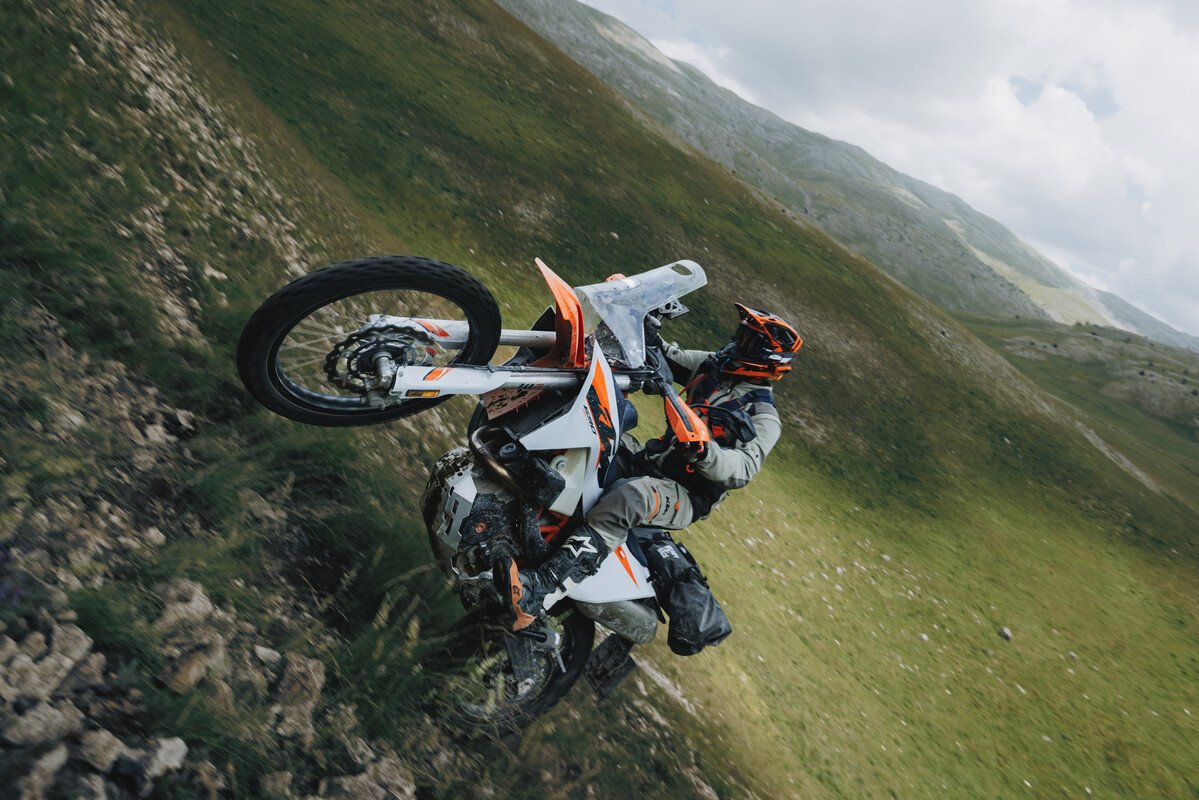
A few articles ago, we asked a question:
Did KTM finally build the 640 Adventure’s successor?
At the time, the answer required some speculation.
We knew KTM was returning to the idea of a large displacement single cylinder rally inspired adventure motorcycle. We knew what the LC4 platform was capable of. And we knew there was a conspicuous hole in KTM’s lineup between the 690 Enduro R and the company’s larger parallel twin Adventure models.
What we didn’t have was the complete production motorcycle.
Now we do.
And KTM has answered the question for us.
The company officially describes the new 2027 KTM 690 Rally as the spiritual successor to the KTM 640 Adventure.
More importantly, the specifications suggest that isn’t merely a convenient piece of marketing nostalgia.
KTM appears to have remembered what made the 640 Adventure interesting in the first place.
Not maximum horsepower.
Not a giant TFT.
Not radar.
Not 500 plus pounds of continent crossing luxury.
The formula was considerably simpler:
A serious off road motorcycle with enough fuel, protection and carrying ability to travel a very long way.
Twenty years later, KTM is trying it again.
The Question Has Changed
When we previously compared the emerging 690 Rally concept with the old 640 Adventure, the question was whether KTM understood what riders actually missed about the 640.
Now that the production motorcycle has been revealed, the question is different:
Did KTM execute the idea correctly?
On paper, the answer looks remarkably close to yes.
The 2027 690 Rally uses KTM’s 692.7cc LC4 single producing a claimed 79 PS roughly 78 horsepower and 73 Nm, or about 53.8 lb-ft, of torque.
It has a six speed transmission.
A chromoly steel trellis frame.
A 21 inch front and 18 inch rear wheel.
WP XPLOR suspension.
265 mm/10.4 inches of front suspension travel.
250 mm/9.8 inches at the rear.
265 mm/10.4 inches of ground clearance.
And, crucially:
5.28 gallons of fuel.
KTM lists weight without fuel at 161.5 kg, or approximately 356 pounds. With a full 5.28 gallon fuel load, that puts the motorcycle roughly around the high 380 pound range before accessories or luggage.
Read those numbers again.
This is a motorcycle with almost 10 inches or more of suspension travel, more than five gallons of fuel, nearly 78 horsepower, and a weight that remains far below most contemporary middleweight adventure motorcycles.
That’s the motorcycle many riders have been asking KTM to build.
The 690 Enduro R Was Always Almost There
The frustrating thing is that KTM already had most of the motorcycle.
The 690 Enduro R has long occupied a strange position.
It’s extraordinarily capable.
It has enough engine for highway travel.
It’s light compared with conventional adventure motorcycles.
Its chassis is genuinely intended for dirt.
But turning one into a long distance adventure motorcycle typically meant adding the things KTM didn’t install at the factory.
More fuel.
Wind protection.
Navigation equipment.
A rally tower.
Improved seating.
Luggage solutions.
Sometimes additional lighting.
By the time owners finished, they had effectively built their own interpretation of a motorcycle KTM once sold from the factory.
A modern 640 Adventure.
The aftermarket recognized this years ago.
Rally kits and auxiliary tanks became an entire cottage industry around the 690 platform.
KTM has finally arrived at the same conclusion.
The Fuel Tanks May Be the Most Important Part
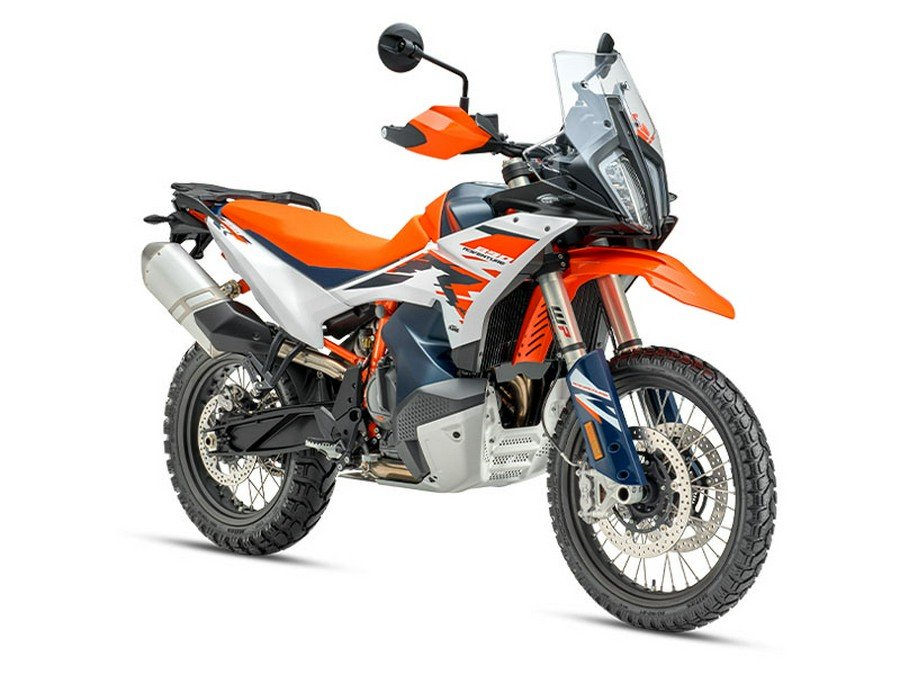
The headline number will be horsepower.
It shouldn’t be.
The most important specification may be 20 liters of fuel capacity.
The standard architecture uses the familiar rear tank, but KTM has added two front-mounted tanks providing another seven liters or 1.84 gallons bringing total capacity to approximately 5.28 gallons.
Even more interestingly, KTM allows the rider to switch between the front, and rear tanks from the handlebar controls.
That changes more than range.
It changes how the motorcycle can carry fuel mass.
Instead of placing all additional fuel high on the motorcycle or hanging a large aftermarket tank somewhere it wasn’t originally intended to go, KTM has integrated the additional fuel into the design.
That’s exactly the sort of engineering a factory rally-adventure motorcycle should have.
And it gets at the fundamental difference between a dual-sport and an adventure motorcycle.
A dual-sport needs enough fuel to reach the next trail.
An adventure motorcycle needs enough fuel that the absence of a gas station doesn’t determine where the trail ends.
The Rally Tower Isn’t Just Styling
The rally tower will inevitably be the visual centerpiece.
It makes the 690 look like something that escaped a rally bivouac.
But its importance isn’t primarily aesthetic.
KTM has integrated a windshield and a relatively minimalist 4.2-inch TFT into the rally cockpit.
The windshield is intended to reduce fatigue during high-speed liaison sections and longer rides.
That’s exactly what the 690 Enduro R lacks as a long-distance motorcycle.
Wind protection isn’t especially important when you’re riding technical terrain at 25 mph.
Ride 300 highway miles to reach that terrain and the equation changes.
This is where the old 640 Adventure understood its mission remarkably well.
It wasn’t a touring motorcycle disguised as a dirt bike.
It was a dirt oriented motorcycle modified just enough to travel.
The 690 Rally appears to follow the same philosophy.
KTM Didn’t Turn It Into an 890
That may be the best news.
It would have been easy for KTM to keep adding equipment.
A bigger display.
More bodywork.
More comfort.
More electronics.
More luggage infrastructure.
More everything.
And eventually the motorcycle would have become another middleweight ADV.
Instead, the specification sheet remains unusually focused.
The 690 Rally is still fundamentally derived from the 690 Enduro R.
That matters.
Because the objective shouldn’t have been:
Build a smaller 890 Adventure.
It should have been:
Build a 690 Enduro R that can cross countries.
Those are very different design briefs.
356lbs Before Fuel Changes Everything
We’ve recently spent considerable time at In A Day’s Ride discussing adventure motorcycle weight.
There’s a reason.
Weight isn’t simply another number on the specification sheet.
Once the pavement ends, it influences nearly everything.
Braking distance on loose surfaces.
Momentum on descents.
How aggressively you can change direction.
How quickly the motorcycle exhausts you.
How intimidating a difficult section becomes.
And perhaps most importantly:
whether you can pick the motorcycle back up.
KTM’s listed 161.5 kg weight without fuel is roughly 356 pounds.
Even after filling 5.28 gallons of fuel, we’re still talking about a motorcycle in a completely different weight class from the conventional 450–500lbs middleweight ADV.
That isn’t a minor advantage.
It’s the entire point.
The Suspension Confirms the Mission
The WP XPLOR hardware reinforces the same idea.
Up front is a fully adjustable 48 mm WP XPLOR fork offering 265 mm/10.43 inches of travel.
At the rear, a linkage-assisted XPLOR shock provides 250 mm/9.84 inches with high and low speed compression, rebound, and preload adjustment.
Ground clearance is 265 mm, also about 10.4 inches.
Those aren’t touring-bike numbers.
They’re serious dirt-bike numbers attached to a motorcycle carrying more than five gallons of fuel.
And that’s where the 690 Rally becomes particularly interesting.
It isn’t simply lighter than most ADV motorcycles.
Its chassis is designed to exploit that lower weight.
There Is One Number Some Riders Won’t Like
Seat height.
35.8 inches.
For most riders that’s tall.
Very tall.
And unlike some adventure motorcycles where a tall seat results primarily from styling or packaging, the 690 Rally has a legitimate reason.
Long suspension travel and substantial ground clearance require space.
KTM chose capability.
Shorter riders will understandably see that as a disadvantage.
But it also illustrates something important about the motorcycle.
KTM didn’t compromise the chassis simply to make the specification sheet more approachable.
This is supposed to be a serious off-road travel motorcycle.
The ergonomics reflect that.
Almost 78 Horsepower Is More Than Enough
Then there’s the engine.
The modern LC4 is a remarkable thing.
A 692.7cc single producing roughly 78 horsepower would have sounded absurd when the 640 Adventure was current.
The old 640 didn’t need that kind of output to cross continents.
Neither does the new motorcycle.
But modern LC4 performance means the 690 Rally shouldn’t suffer from the traditional compromise associated with large single cylinder travel bikes.
Highway performance.
Passing traffic.
Climbing long grades with luggage.
Maintaining interstate speeds.
All should be substantially easier than they were on earlier big singles.
The important question won’t be whether it has enough power.
It will be whether KTM has made that power controllable and comfortable enough for long distance travel.
The Electronics Look Appropriately Focused
The 690 Rally isn’t technologically primitive.
Nor should it be.
Modern electronics can make an adventure motorcycle better when they’re used to solve actual riding problems rather than simply inflate a feature list.
The motorcycle incorporates ride by wire, selectable ABS, ride modes, and Quickshifter+.
What matters will be how easily those systems can be configured once the road turns to dirt.
Off-road electronics should disappear into the background.
If a rider has to spend five minutes navigating menus every time the terrain changes, the technology has failed.
The best systems are the ones you stop thinking about.
This Is What the 640 Adventure Was Trying to Be
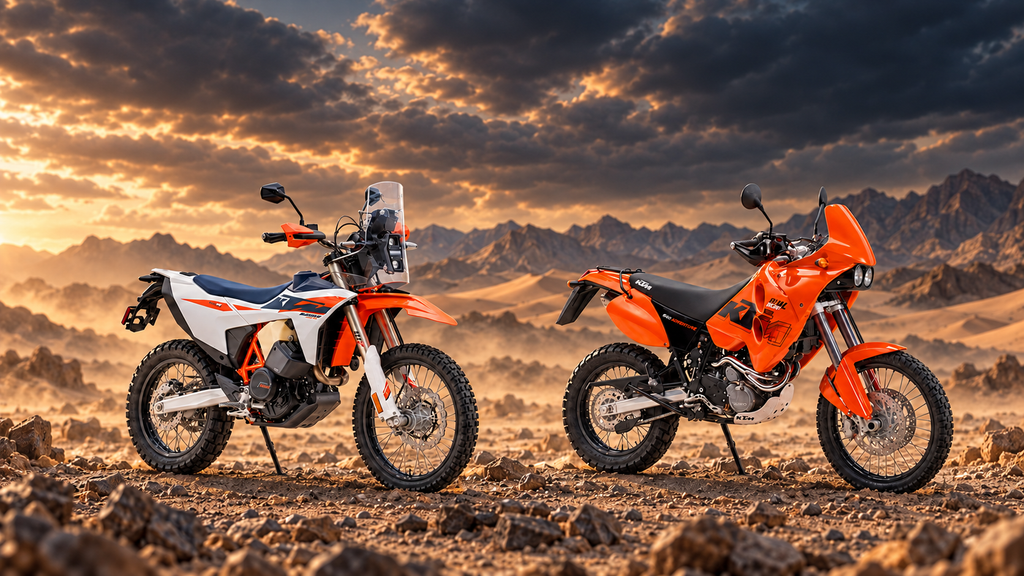
It’s tempting to compare the two motorcycles purely through specifications.
That’s not really the point.
The 690 is vastly more powerful.
Its suspension is more sophisticated.
Its engine is smoother and more advanced.
Its electronics belong to another era.
The important similarity is philosophical.
The 640 Adventure wasn’t trying to be a smaller touring motorcycle.
It was trying to make an off-road motorcycle capable of traveling a very long way.
That’s the idea KTM appears to have rediscovered.
And KTM itself invoking the 640 Adventure when introducing the 690 Rally makes the connection explicit.
The BDR Test
This is where the motorcycle gets particularly interesting for us.
Our recurring test for an adventure motorcycle is relatively straightforward.
Could you:
Leave home.
Ride several hundred highway miles.
Start a BDR.
Spend days riding dirt, rocks, two-track, mountain passes, and occasional technical sections.
Carry camping equipment, tools, food, and water.
Finish the route.
Then ride home.
Without a trailer.
The 690 Rally appears almost purpose built around that scenario.
Five plus gallons of fuel.
Real wind protection.
A strong highway capable engine.
Serious suspension.
21/18in wheels.
Low weight.
Proper ground clearance.
That is an unusually compelling BDR specification sheet.
But We Still Don’t Know the Most Important Things
A specification sheet isn’t a road test.
We still need answers.
How comfortable is the seat after six hours?
How much vibration reaches the rider at sustained highway speeds?
How effective is the windshield?
How does the front fuel load affect steering?
How much heat reaches the rider?
How easily does luggage mount?
How does the suspension behave when loaded with camping gear?
How accessible are routine maintenance points?
How vulnerable are the front tanks and rally bodywork after a fall?
And perhaps most importantly:
How much will it cost?
As of this writing, KTM has not announced U.S. MSRP.
That number could change the entire conversation.
Price May Decide Whether KTM Nailed It
This motorcycle becomes extremely compelling at the right price.
At the wrong one, it becomes an expensive specialty machine.
That’s especially important because riders considering a 690 Rally have alternatives.
A Ténéré 700.
A used 890 Adventure R.
A 690 Enduro R with aftermarket equipment.
A Husqvarna 701 Enduro build.
An Ibex 450 at the opposite end of the price spectrum.
Perhaps even a proper dual-sport.
The 690 Rally’s advantage is supposed to be that KTM has already integrated the pieces.
If the factory solution costs dramatically more than building one yourself, that argument weakens.
So price remains the missing specification.
There’s Another Question: Reliability
The LC4 platform is established.
That’s valuable.
But long distance adventure travel asks different questions than weekend riding.
A BDR motorcycle isn’t merely expected to perform.
It needs to keep performing hundreds of miles from the nearest dealer.
The 690 Rally’s electronics, fuel-management system, front tanks, and rally structure add complexity compared with the base Enduro R.
We need real world miles before declaring the motorcycle a new benchmark.
That’s not skepticism unique to KTM.
It’s the standard every adventure motorcycle should meet.
The Timing Couldn’t Be Better
The adventure category is changing.
At one end, motorcycles like the CFMOTO Ibex 450 and KTM 390 Adventure R are proving that smaller machines can deliver genuine adventure capability.
At the other, heavyweight ADV motorcycles continue offering extraordinary touring comfort, and performance.
But between those worlds is a group of riders asking for something very specific:
Give us a motorcycle light enough to ride like a big dual sport, but equipped well enough to travel like an ADV.
That’s exactly where the 690 Rally lands.
Maybe the Industry Took Twenty Years to Come Back Around
We’ve argued recently that adventure motorcycles didn’t necessarily become better by becoming bigger.
They became better at certain things.
Highway travel.
Passenger comfort.
Electronics.
Luggage capacity.
Long distance pavement.
But capability isn’t one-dimensional.
As motorcycles became better at crossing continents on pavement, many became more difficult to manage when the route deteriorated.
The old 640 Adventure represented another solution.
Enough engine.
Enough fuel.
Enough protection.
Serious suspension.
Minimal unnecessary mass.
Maybe that wasn’t an outdated formula.
Maybe it was simply waiting for modern technology to catch up.
KTM Actually Did It
We originally asked whether the 690 Rally could become the successor to the 640 Adventure.
We don’t need to speculate about KTM’s intention anymore.
KTM says that’s exactly what it is.
And for once, the marketing claim appears to match the engineering.
The new motorcycle has the big single.
The fuel.
The suspension.
The rally cockpit.
The 21/18 inwheels.
The ground clearance.
And most importantly, the weight.
What remains is to discover whether those ingredients work together as well on a week long adventure as they do on a specification sheet.
If they do, KTM may have built something more important than another new adventure motorcycle.
It may have revived an entire category.
The travel enduro.
A motorcycle that doesn’t ask how much equipment we can add before calling it an adventure bike.
But instead asks:
How much motorcycle do we actually need to go a very long way?
Twenty years after the 640 Adventure helped answer that question, KTM is asking it again.
This time, we’re listening.
Continue Reading
690 Rally vs 640 Adventure: Did KTM Finally Build the 640’s Successor?
Our original comparison and the argument for why the 640 Adventure formula still matters.
When Did Adventure Bikes Get Too Big?
How ADV motorcycles evolved from travel capable dirt bikes into heavyweight adventure tourers.
The Best Adventure Bike Isn’t the Biggest One: How to Choose the Right ADV by Mission
Why choosing a motorcycle should begin with where and how you actually ride.
The Lightweight ADV Sweet Spot: Ibex 450 vs Himalayan 450 vs KTM 390 Adventure R
Three different approaches to solving the lightweight adventure bike problem.