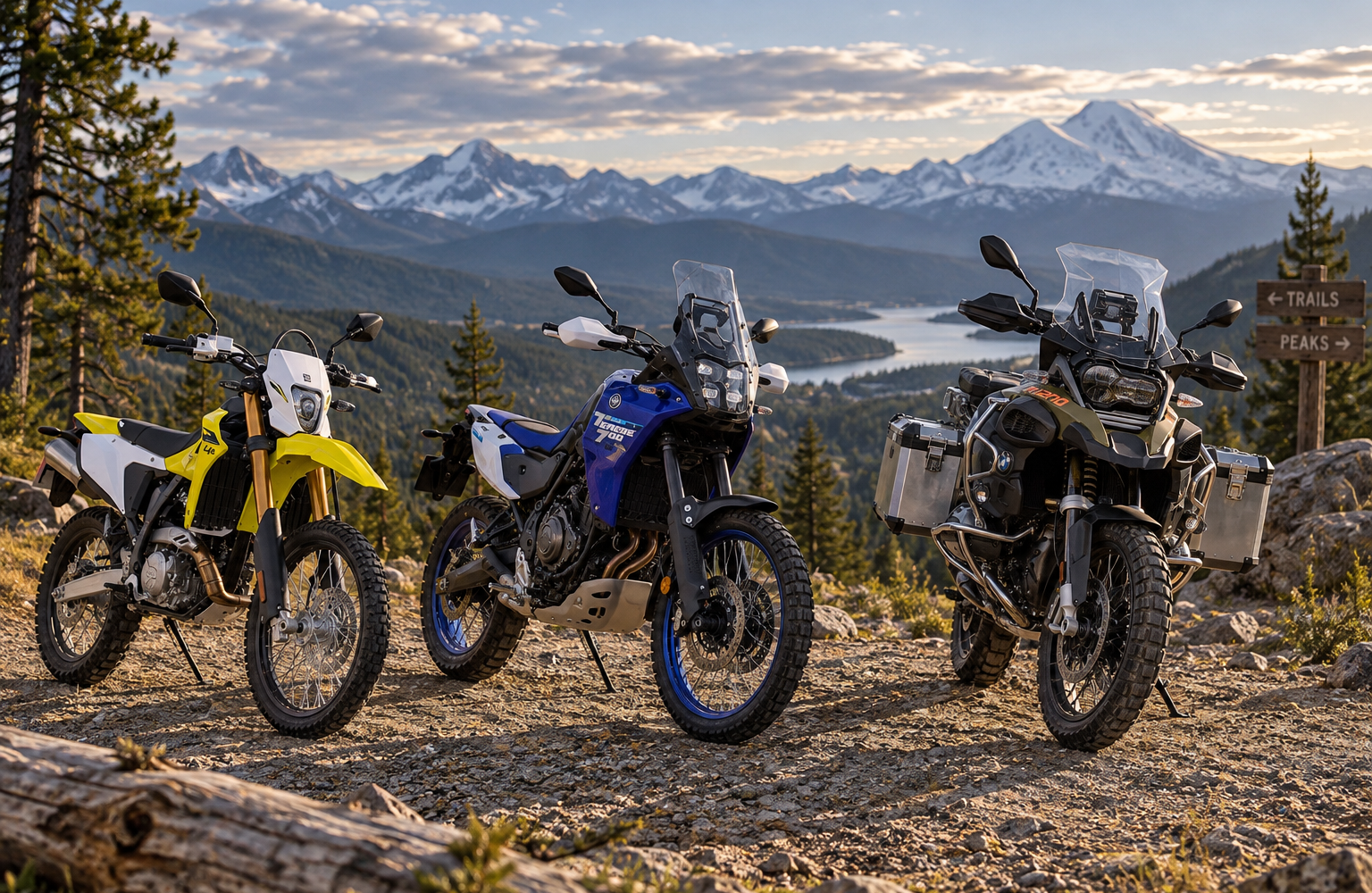
Walk into almost any motorcycle dealership and there’s a natural temptation.
Look at the bigger bike.
More engine.
More suspension.
More fuel.
More technology.
More equipment.
More capability.
At least, that’s how the numbers make it appear.
Adventure motorcycles encourage this especially well because the category is built around possibility.
Maybe you’ll cross the country.
Maybe you’ll ride Alaska.
Maybe you’ll tackle a Backcountry Discovery Route.
Maybe you’ll carry a passenger.
Maybe you’ll disappear into the desert with camping gear for a week.
So buying the motorcycle capable of doing everything sounds perfectly rational.
Until you realize that building a motorcycle capable of everything usually makes it heavier, more expensive, and harder to manage during the exact moments when adventure riding becomes difficult.
That’s why the most important question when choosing an ADV bike isn’t:
“Which motorcycle is best?”
It’s:
“Best for what?”
Stop Shopping by Engine Size
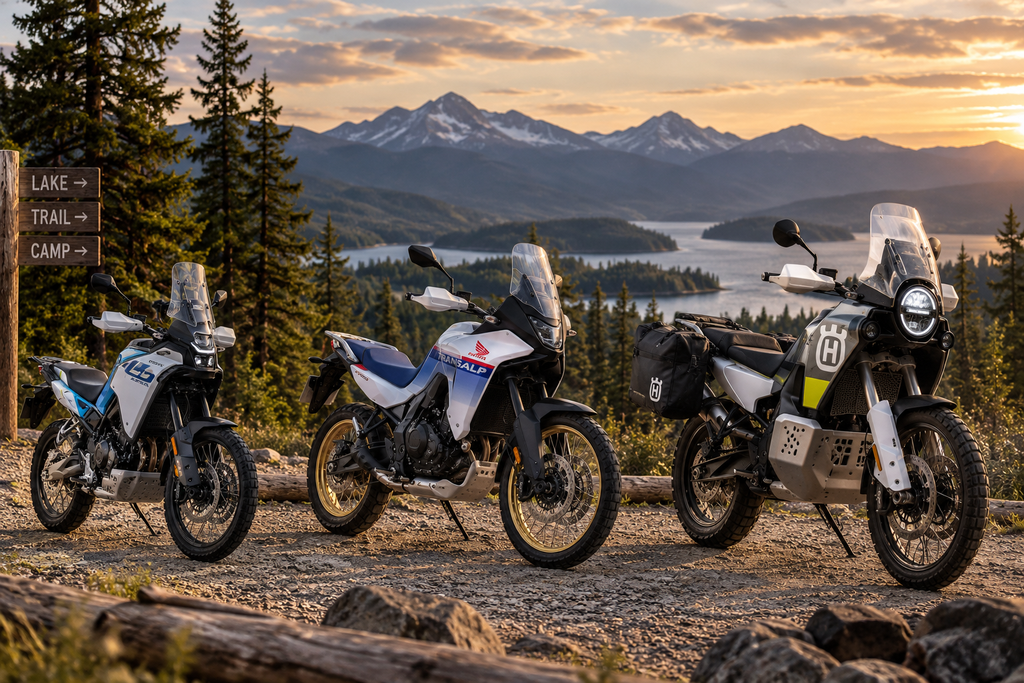
Motorcycle buyers have been conditioned to think of displacement as a hierarchy.
- 250cc
- 450cc
- 600cc
- 1000cc
Bigger numbers imply progression.
But adventure motorcycles don’t really work that way.
A 1200cc ADV isn’t an upgraded 450.
And a 450 isn’t simply a cheaper 1200.
They’re tools designed around different compromises.
A large ADV typically gives you more:
Highway power.
Passenger capacity.
Wind protection.
Luggage capacity.
Long distance comfort.
Technology.
But the smaller motorcycle often gives you more:
Manageability.
Confidence.
Ease of recovery.
Lower running costs.
Freedom to explore difficult terrain.
Neither side automatically wins.
The question is which capabilities actually matter during your riding.
Start With the Mission, Not the Motorcycle
Before comparing horsepower, suspension travel or TFT screens, describe what a typical trip actually looks like.
Not the hypothetical trip you may someday take.
The one you’re realistically going to do.
Maybe it’s:
Ride 250 miles of pavement Friday afternoon.
Spend Saturday exploring gravel and forest roads.
Camp overnight.
Ride home Sunday.
That’s one mission.
Or perhaps it’s:
Load the bike with camping gear.
Ride 500 interstate miles.
Spend a week on a BDR.
Ride the same motorcycle home.
Completely different mission.
Or:
Two people.
Hard luggage.
Hotels.
Paved mountain roads.
Occasional gravel.
Again, different.
The motorcycle should follow the mission.
Not the other way around.
Mission 1: Highway-Heavy Adventure Touring
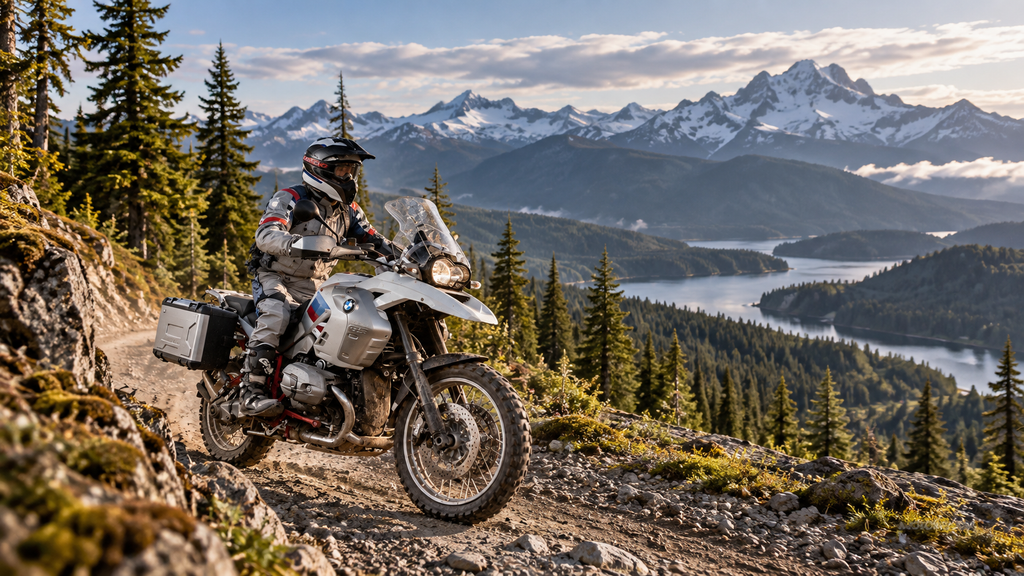
Let’s start at the large end of the spectrum.
Suppose your riding looks like:
Long interstate days.
Two up travel.
Hard luggage.
High speeds.
Cold weather riding.
Large distances between destinations.
Occasional gravel or dirt roads.
A large adventure motorcycle makes tremendous sense.
This is where motorcycles in the BMW GS Adventure class shine.
The current standard BMW R 1300 GS itself weighs 523 pounds road-ready and fueled, carries five gallons of fuel and offers more than 500 pounds of allowable payload.
Those numbers aren’t disadvantages when the motorcycle’s job is carrying people and equipment across large distances.
Weight contributes to highway stability.
A larger engine provides effortless passing.
A substantial chassis handles passengers and luggage.
Sophisticated electronics can make long days easier.
If that describes the majority of your riding, buying a smaller motorcycle solely because someone online insists “lighter is always better” makes little sense.
Best Fit
For highway dominant adventure touring, prioritize:
Large displacement.
Wind protection.
Payload.
Passenger accommodations.
Fuel range.
Cruise control.
Comfort.
Dealer support.
Here, 500 plus pounds isn’t automatically too much motorcycle.
It may be exactly the right motorcycle.
Mission 2: Long Distance Touring With Real Dirt
Now change the trip.
You still need to travel hundreds of highway miles.
But the destination includes:
Gravel.
Forest roads.
Ruts.
Rocky climbs.
Loose surfaces.
Maybe several days on a BDR.
Now weight starts carrying a penalty.
This is where the 700-to-900cc ADV class makes such a compelling case.
The Middleweight Argument
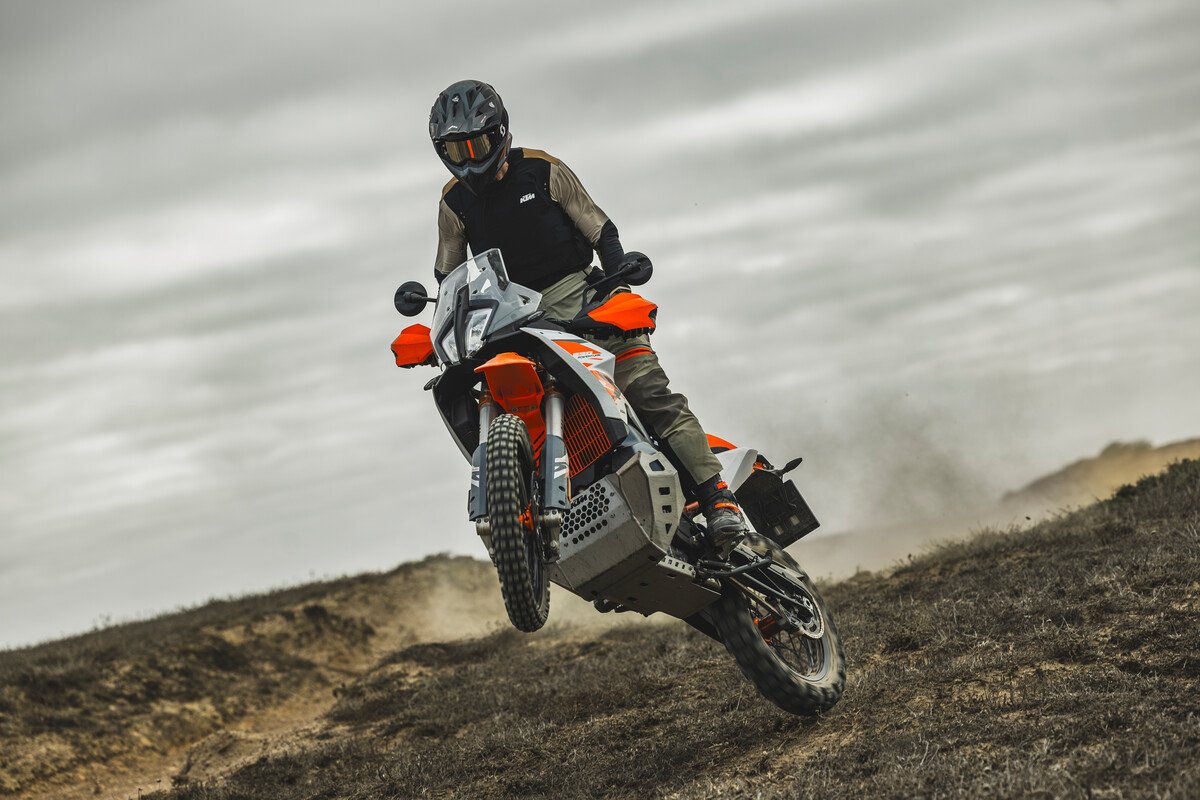
Take something like the KTM 890 Adventure R.
It makes 105 PS and 100 Nm, carries roughly 5.28 gallons of fuel and uses 9.45 inches of WP suspension travel at both ends. Fully fueled, KTM lists it at 215 kg about 474 pounds.
That’s still a substantial motorcycle.
But compare its mission with a heavyweight luxury ADV and the intent is different.
21/18 inch wheels.
Long suspension.
Serious ground clearance.
Ergonomics designed around standing.
Off-road ABS.
A chassis deliberately intended for difficult terrain.
This class tries to preserve enough road comfort for real travel while giving away less once the pavement disappears.
For many riders, this is the traditional one bike ADV solution.
Mission 3: BDR Travel
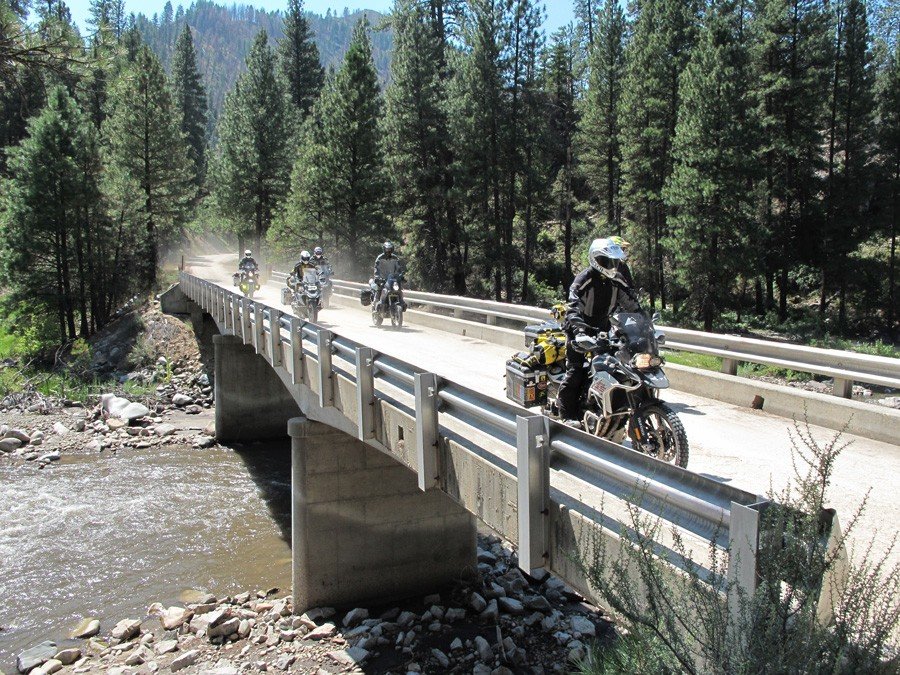
Photo credit: RideBDR.com 2026
Suggested image: ADV bike carrying soft luggage on a BDR style dirt road.
BDRs expose motorcycle compromises better than almost any other type of riding.
A BDR trip may include:
Highway transit.
Fast gravel.
Loose climbs.
Rocky sections.
Mud.
Ruts.
Deep sand.
Camping equipment.
Tools.
Water.
Unexpected detours.
And fatigue.
A motorcycle needs enough road capability to reach the route while remaining manageable once conditions deteriorate.
That’s why weight matters enormously here.
The Question Isn’t Whether a Big Bike Can Do It
Of course it can.
Skilled riders have taken huge adventure motorcycles through terrain most people would hesitate to ride on an enduro.
That’s not the important test.
The important question is:
Which motorcycle makes the trip easier for the rider?
A 600 pound ADV and a 420 pound ADV may both complete the same route.
But they’re unlikely to demand the same amount of energy, confidence or skill.
That difference becomes increasingly important after several days.
For BDRs, Think About the Bad 5 Percent
Here’s a useful way to choose a motorcycle.
Don’t select it solely around the easiest 95 percent of the ride.
Think about the worst 5 percent.
The steep rocky climb.
The washed out road.
The mud hole.
The awkward turnaround.
The place where you have to drag the rear wheel sideways.
The moment when you drop it facing downhill.
That’s where your motorcycle choice suddenly matters.
A motorcycle doesn’t have to be easier everywhere to be the better tool. It may only need to be dramatically easier when things go wrong.
For many BDR riders, this pushes the ideal machine toward the lighter side of the spectrum.
Mission 4: Backcountry Exploration
Now imagine the primary purpose isn’t covering distance.
It’s exploring.
Forest roads.
Unknown trails.
Two track.
Dead ends.
Old logging roads.
Camping.
Riding alone.
This is where lightweight adventure motorcycles become extremely compelling.
The Ibex 450 Type of Motorcycle
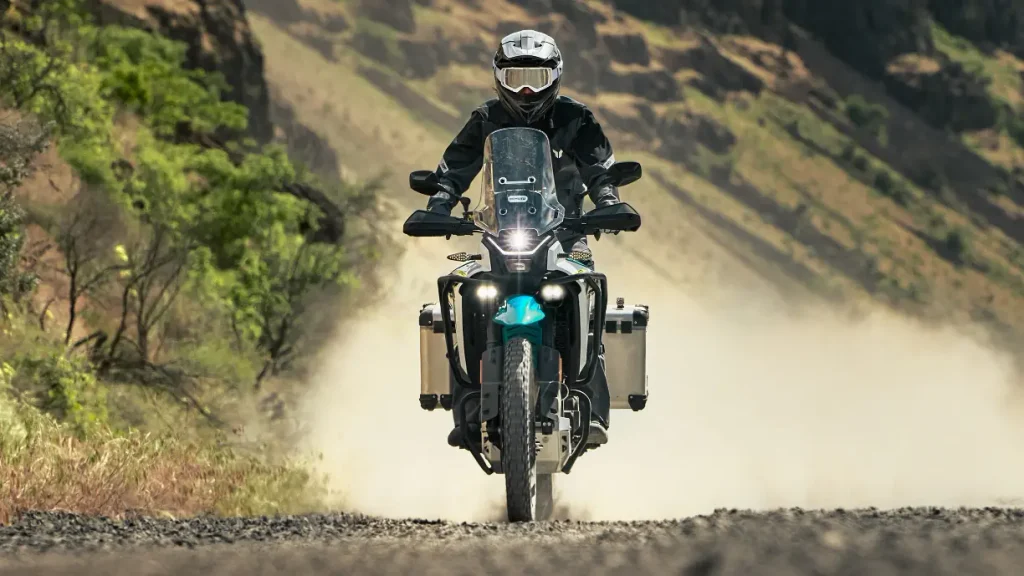
A motorcycle like the CFMOTO Ibex 450 asks the rider to accept less highway performance in exchange for something very useful off pavement:
Less motorcycle.
That can be a feature.
A lightweight twin with adventure ergonomics, 21/18-inch wheels, useful fuel range, and enough road ability to connect trails may be a better exploration tool than a much more powerful machine.
The point isn’t that a 450 has greater absolute performance.
It doesn’t.
It’s that the consequences of uncertainty become smaller.
Exploration Is Mostly About Confidence
You’re riding alone and find an unfamiliar road.
It becomes narrower.
Then rougher.
There’s no cell service.
You don’t know whether there’s room to turn around.
Which motorcycle encourages you to keep going?
That’s an important measure of ADV capability.
A lighter motorcycle is:
Easier to turn around.
Easier to pick up.
Less intimidating on loose surfaces.
Less exhausting during repeated low speed maneuvering.
Often cheaper to damage.
None of those things appears prominently in a brochure.
But they’re extremely relevant when actually exploring.
Mission 5: Technical Dirt
At some point, an adventure motorcycle stops being the best tool.
This is worth acknowledging.
If your typical riding includes:
Singletrack.
Repeated ledges.
Deep mud.
Hard enduro style climbs.
Tight woods.
Very difficult rocky terrain.
Then the question may not be which adventure bike to buy.
It may be whether you should be buying a dual sport or enduro instead.
Don’t Ask an ADV Bike to Be Something It Isn’t
There’s a tendency to modify large adventure motorcycles toward increasingly technical use.
Better suspension.
Knobby tires.
Protection.
Lighter exhaust.
Skid plates.
Crash bars.
Eventually you’ve spent thousands of dollars trying to make a heavy motorcycle imitate a lighter one.
At some point, buying the lighter motorcycle makes more sense.
This doesn’t mean you need a competition enduro for every gravel road.
It means recognizing when the mission has crossed categories.
Mission 6: Two Up Adventure Travel
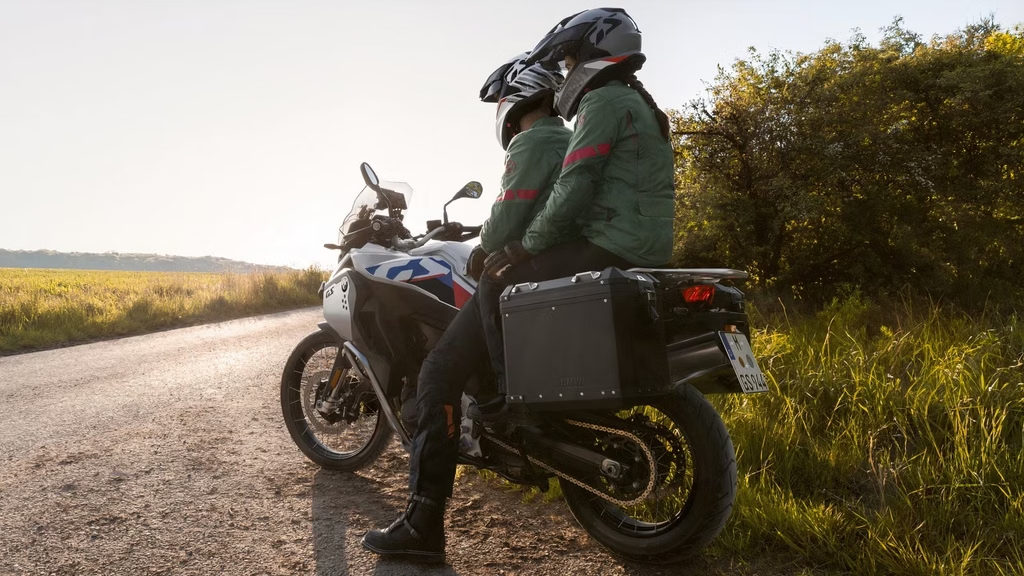
Passengers change the calculation significantly.
Suddenly we care much more about:
Payload.
Seat space.
Rear suspension capacity.
Engine torque.
Braking.
Wind protection.
Luggage capacity.
A 450 that makes wonderful sense for solo backcountry travel may make far less sense carrying two people and a week’s equipment.
This is where larger middleweight and heavyweight bikes earn their mass.
Don’t Buy for the Passenger Who Never Comes
There’s a trap here too.
Some riders choose a huge ADV because they might carry a passenger.
Then ride alone 99 percent of the time.
That’s worth thinking about.
Buy around the actual mission.
If you genuinely tour two up regularly, passenger capability deserves substantial weight in the decision.
If someone joins you once every three years, perhaps it shouldn’t dictate every mile you ride in between.
Mission 7: The One Motorcycle Garage
This is the hardest category.
You commute.
Ride weekend pavement.
Take trips.
Ride gravel.
Want to do BDRs.
Carry camping gear.
Maybe occasionally ride two up.
And there’s only room or budget for one motorcycle.
Now we’re asking for competing qualities simultaneously.
And this is exactly why middleweight adventure motorcycles became so popular.
The One Bike Compromise
The ideal one bike ADV probably needs:
Enough horsepower for highway travel.
Reasonable wind protection.
Useful fuel capacity.
21/18 or similarly capable wheels.
Enough suspension for real off road use.
Manageable weight.
Soft luggage compatibility.
Cruise control is increasingly desirable.
Passenger capability.
Good dealer and parts support.
There isn’t a perfect motorcycle because some of those qualities conflict.
Adding comfort generally adds weight.
Adding range adds fuel mass.
Adding power usually increases engine and chassis demands.
Adding luggage capacity requires structure.
The one-bike ADV isn’t about eliminating compromise.
It’s about choosing the compromises you notice least.
Maybe 700–900cc Is the One-Bike Zone
For riders who genuinely need one motorcycle to cover nearly everything, the 700 to 900cc category makes a strong argument.
Enough engine for serious road work.
Enough chassis for luggage.
Still manageable enough for actual dirt.
That’s why motorcycles such as the Ténéré 700 and KTM 890 Adventure family occupy such an important position.
They’re not necessarily best at one thing.
They’re difficult to exclude from almost anything.
And that’s valuable.
But a 450 May Still Be the Better One-Bike Answer
Here’s where rider priorities matter more than displacement.
Suppose your riding consists of:
20% highway.
30% secondary roads.
30% gravel.
20% rough dirt.
A lightweight 450 starts looking excellent.
Now reverse that:
60% highway.
25% secondary roads.
10% gravel.
5% dirt.
The same motorcycle becomes harder to justify.
The motorcycle didn’t change.
The mission did.
Start With Percentages
This is one of the simplest ways to shop intelligently.
Write down your realistic riding split.
For example:
Rider A
50% interstate
30% paved backroads
15% gravel
5% rough dirt
Probably wants a larger middleweight or heavyweight.
Rider B
10% interstate
30% secondary roads
30% gravel
30% rough dirt
Probably wants a lightweight ADV or dirt oriented middleweight.
Rider C
40% pavement
30% gravel
20% BDR terrain
10% technical sections
That’s where bikes in the Ténéré/890/690 spectrum become especially interesting.
The exact percentages aren’t scientific.
They force honesty.
Then Add Your Worst Case Scenario
Once you’ve identified normal use, ask what goes wrong.
Do you ride alone?
Far from cell service?
In sand?
In mud?
At elevation?
Do you frequently need to pick the motorcycle up?
Do you ride when tired?
Are you comfortable managing 500 pounds at walking speed?
These questions matter more than whether one motorcycle has ten additional horsepower.
Weight Should Be a Buying Criterion
Horsepower determines how quickly the motorcycle accelerates. Weight often determines where you’re willing to take it.
Adventure buyers routinely compare:
Power.
Torque.
Suspension travel.
Fuel capacity.
Price.
Weight should receive equal billing.
And don’t stop at published curb weight.
Your motorcycle will probably gain:
Crash protection.
A skid plate.
Luggage racks.
Bags.
Tools.
Water.
Camping gear.
Navigation equipment.
Spare tubes or repair gear.
Maybe another 40, 60, or 80 pounds.
A 500-pound motorcycle can become a 575-pound travel package surprisingly quickly.
Fuel Range Matters, But Bigger Isn’t Always Better
Large tanks sound ideal for ADV riding.
Sometimes they are.
But fuel weighs roughly six pounds per U.S. gallon.
Carry three additional gallons and you’ve added nearly 20 pounds.
If you routinely ride where gas stations are 180 miles apart, that’s valuable weight.
If you’re stopping every 100 miles anyway, perhaps not.
Range should be matched to geography.
Not fear.
Suspension Should Match Your Pace
More suspension travel isn’t automatically better.
If you ride slowly on maintained gravel, you probably don’t need race derived suspension.
If you repeatedly ride rocks at speed, you may.
What’s more important is whether the suspension is properly:
Sprung.
Damped.
Adjusted.
And capable of supporting you plus luggage.
A modest suspension set up correctly can be more useful than expensive suspension configured badly.
Wheel Size Tells You About Intent
Wheel sizes provide a quick clue to the motorcycle’s priorities.
A 21 inch front remains strongly associated with dirt focused ADV machines.
It rolls over obstacles better and supports more aggressive off road tire options.
A 19 inch front generally gives a stronger pavement bias while retaining substantial dirt road ability.
At the rear, an 18 inch wheel offers broader dirt oriented tire options than many 17 inch setups.
This doesn’t determine what a bike can do.
It tells you what compromises the engineers prioritized.
Electronics: Decide What You Actually Value
Modern adventure bikes can include:
Cornering ABS.
Traction control.
Off road ABS.
Multiple ride modes.
Electronic suspension.
Quickshifters.
Cruise control.
Radar.
Hill hold systems.
Phone integration.
Heated seats.
Some of this is extremely useful.
Cruise control, for example, can make long highway transfers significantly more pleasant.
Good off road ABS can genuinely help.
Other features may matter little for your use.
Technology isn’t bad.
But paying for features you neither need nor understand doesn’t make the motorcycle more capable.
Reliability Means More Than Engine Failure
When riders discuss ADV reliability, the conversation often becomes:
“Will the engine blow up?”
That’s too narrow.
For travel motorcycles, reliability also includes:
Parts availability.
Dealer coverage.
Ease of maintenance.
Common consumables.
Diagnostic requirements.
Crash survivability.
Wheel durability.
Electrical complexity.
Accessory availability.
And how difficult the motorcycle is to repair far from home.
A machine can have an exceptionally reliable engine and still be frustrating to travel with.
Dealer Network Can Be Part of Capability
This becomes increasingly important on longer trips.
If you’re riding across several states or countries the size of the support ecosystem matters.
Can you get a:
Brake lever?
Wheel bearing?
Fuel pump?
Sensor?
Chain slider?
Air filter?
A motorcycle’s specifications don’t tell you that.
For a local weekend bike, it may matter very little.
For a continent-crossing travel motorcycle, it can matter enormously.
Price Changes How You Ride
A $6,000 motorcycle and a $25,000 motorcycle produce different psychological reactions.
Most riders don’t like dropping motorcycles.
But there’s often a difference between dropping a comparatively inexpensive machine and watching thousands of dollars’ worth of bodywork hit the ground.
Adventure motorcycles are tools.
If price makes you unwilling to use the motorcycle for its intended mission, the more expensive bike may actually reduce capability.
That’s worth considering.
Buying the Motorcycle Is Only the Beginning
A real adventure-bike budget may include:
Protection.
Luggage.
Tires.
Navigation.
Riding gear.
Camping equipment.
Tools.
Maintenance.
Training.
Travel.
If purchasing the motorcycle consumes your entire budget, you may own a wonderful ADV bike while doing very little adventuring.
A cheaper motorcycle plus $5,000 worth of trips may create more adventure than the premium motorcycle parked in the garage.
Don’t Ignore Ergonomics
Spec sheets can’t tell you whether a motorcycle fits.
Sit on it.
Better yet, stand on it.
Can you comfortably reach the bars?
Are the footpegs where you expect?
Can you move forward and backward while standing?
Does the tank interfere with your knees?
Can you reach the ground sufficiently for your confidence level?
Can you lift it from the side stand without strain?
These questions matter tremendously in the real world.
Seat Height Isn’t the Same as Motorcycle Size
A taller seat doesn’t always mean the motorcycle is harder to manage.
A narrow seat can make a tall motorcycle surprisingly accessible.
A wide seat can make a lower motorcycle feel taller than the specification suggests.
Suspension sag also matters.
So does center of gravity.
Judge the entire package.
Not one number.
Your Skill Level Matters, but Not the Way You Think
Beginners are commonly told:
Buy the smaller motorcycle.
That’s often good advice.
But experienced riders sometimes benefit even more from smaller machines.
Why?
Because experience teaches you what actually matters.
You stop needing horsepower for reassurance.
You become more aware of fatigue.
You understand how much easier technical riding becomes when weight disappears.
You know what happens when conditions deteriorate.
Choosing a smaller bike isn’t necessarily a beginner decision.
It can be a highly experienced one.
Don’t Buy a Motorcycle for Your Fantasy Self
This may be the most useful buying advice in the entire article.
It’s easy to imagine:
Crossing Mongolia.
Racing through Baja.
Riding two up to Alaska.
Crossing a desert.
Touring South America.
But what are you doing next Saturday?
If the answer is:
Ride local forest roads.
Do a weekend camping trip.
Explore gravel around home.
Ride a regional BDR.
Then buy for that.
If someday you actually need a motorcycle for crossing Mongolia, solve that problem when it becomes real.
A Simple ADV Mission Matrix
| Primary Mission | Best Starting Category |
|---|---|
| Interstate touring | Large ADV |
| Two up long-distance travel | Large ADV |
| Paved + gravel touring | Middleweight ADV |
| One bike mixed use | Middleweight ADV |
| BDR travel | Lightweight or dirt-focused middleweight |
| Solo backcountry exploration | Lightweight ADV |
| Technical dirt with some road | Lightweight ADV / dual-sport |
| Primarily technical off-road | Dual sport / enduro |
| Budget adventure travel | Lightweight ADV |
| Maximum highway comfort | Large ADV |
This is deliberately a starting point.
Riders will always cross categories.
That’s part of the fun.
But the table reveals something important:
There is no column labeled “best motorcycle.”
What About the Current Bikes We’ve Been Discussing?
The motorcycles we’ve covered recently fit this framework surprisingly well.
CFMOTO Ibex 450
Mission: lightweight exploration, BDRs, mixed travel.
Its appeal is that it preserves enough road ability while removing weight, cost, and intimidation.
Royal Enfield Himalayan 450
Mission: slow-travel adventure, back roads, gravel, camping, and exploration.
It emphasizes the journey rather than outright performance.
KTM 390 Adventure R
Mission: riders who lean more heavily toward technical dirt.
The lighter chassis and more aggressive suspension make its priorities clear.
Yamaha Ténéré 700
Mission: one bike travel with a substantial dirt bias.
This is the classic bridge between lightweight exploration bikes and larger middleweights.
KTM 890 Adventure R
Mission: serious off-road capability without sacrificing large amounts of road performance.
The 2026 bike retains 9.45 inches of WP travel, 21/18 wheels, 5.28 gallons of fuel, and a roughly 474-pound fully fueled weight.
CFMOTO Ibex 950
Mission: performance oriented one bike ADV travel.
The argument for the 950 isn’t that everyone needs 112 horsepower. It’s that it attempts to combine substantial road performance with genuinely dirt oriented chassis choices.
BMW GS Class Motorcycles
Mission: long distance travel first, extraordinarily broad secondary capability.
The standard R 1300 GS alone shows how much touring capability can be packaged into a modern ADV, with a 523 pound fueled weight, and 502 pound payload rating.
None of these motorcycles is inherently superior.
They are optimized around different answers to the same question.
The Three Questions We’d Ask Before Buying Any ADV
If you’re standing in the dealership trying to decide, forget the horsepower figures for a moment.
Ask:
1. What will I do 80 percent of the time?
Buy for this.
2. What is the hardest terrain I realistically expect to ride?
Make sure the motorcycle doesn’t prevent this.
3. What compromise am I happiest living with?
Because there will always be one.
Maybe you’re willing to tolerate highway vibration for lower weight.
Maybe you’re willing to wrestle more weight off road for better touring comfort.
Maybe you’re happy to pay more for high-end suspension.
Maybe simplicity matters more.
That’s the real decision.
So What Is the Best Adventure Bike?
The answer is frustratingly simple.
The one that fits your mission.
A 450 can be a better adventure motorcycle than a 1300.
A 1300 can be a vastly better adventure motorcycle than a 450.
Both statements can be true.
Put them on different trips.
The mistake is defining capability with a specification sheet instead of a destination.
The Biggest Motorcycle Is Rarely the Answer to Every Question
Motorcycle manufacturers have become extraordinarily good at building machines that can do almost everything.
That’s an impressive achievement.
But there is a difference between can and should.
A heavyweight adventure motorcycle can ride a difficult BDR.
A lightweight ADV can cross the country.
Neither necessarily represents the ideal tool for those jobs.
Choosing the right motorcycle is about deciding where you want the machine to excel and where you’re willing to compromise.
Which leads back to a principle we’ve been circling throughout this series:
An adventure motorcycle should increase the number of places you’re willing to go, not reduce them.
If weight makes you turn around, it’s too heavy for your mission.
If limited power makes every highway connection miserable, it’s too small for your mission.
If price makes you terrified to scratch it, it may be too expensive for your mission.
If poor range prevents you from reaching where you want to go, it’s the wrong motorcycle.
The ideal ADV isn’t the bike with the most horsepower.
Or the most technology.
Or the largest fuel tank.
Or the longest suspension travel.
It’s the motorcycle that disappears underneath you while you concentrate on where you’re going.
And that might be a 450.
A 700.
An 890.
Or a 1300.
Choose the mission first.
Then choose the motorcycle.
Continue Reading
When Did Adventure Bikes Get Too Big?
The broader argument behind the shift back toward lighter ADV motorcycles.
The Lightweight ADV Sweet Spot: Ibex 450 vs Himalayan 450 vs KTM 390 Adventure R
For riders leaning toward the lighter end of the spectrum.
Is the Ibex 450 the Adventure Bike Most Riders Actually Need?
The case for deliberately choosing less motorcycle.
CFMOTO Ibex 950 vs KTM 890 Adventure R: How Close Are They Really?
For riders looking for a high-performance middleweight/large ADV.
690 Rally vs 640 Adventure: Did KTM Finally Build the 640’s Successor?
For the travel enduro side of the argument.